In thinking about the top/bottom five all time most devastating defeats in my history as a sports fan, I noticed a pattern - of course the worst losses, those which made you want to call in sick, or drink for two days, or which woke you up in the middle of the night four days later with the play in question going through your mind, were ones that my team was supposed to win, or was in a great position to win.
I looked at some history, and for most of my life the teams I supported were truly awful - the Pacers in the 80's were so bad that they literally gave away tickets to my high school honors society, student council and band (all seven of them). And when we took the bus down to Indy to watch that game, we were 25 of about 6,000 people in attendance. That was 1986, and our odds were slightly under half that we'd see the Pacers win. And we had a blast.
Pacers Year by Year history:
1991-92 40 42 0.488
1990-91 41 41 0.500
1989-90 42 40 0.512
1988-89 28 54 0.341
1987-88 38 44 0.463
1986-87 41 41 0.500
1985-86 26 56 0.317
1984-85 22 60 0.268
1983-84 26 56 0.317
1982-83 20 62 0.244
1981-82 35 47 0.427
TOTS: 359 543 0.398
In the years while I was developing loyalty to the Pacers, they had one winning season - and that by 2 games. They were brutal. The expectation was that they would lose, and if they snuck up on someone and actually won a game, well, that was a bonus, and if they actually made the Playoffs, are you kidding!, that was fantastic. We were usually an 8 seed and the 1 seed usually made quick work of us while looking ahead to a team that mattered.
What about my true football love, the Colts?
1984 4 12 0.250
1985 5 11 0.313
1986 3 13 0.188
1987 9 6 0.563
1988 9 7 0.563
1989 8 8 0.500
1990 7 9 0.438
1991 1 15 0.063
1992 9 7 0.563
1993 4 12 0.250
1994 8 8 0.500
1995 9 7 0.563
1996 9 7 0.563
1997 3 13 0.188
1998 3 13 0.188
TOT: 91 148 0.381
The first 15 years of my love of the Colts they lost 2 out of 3 games. They made the playoffs twice, in 1987 when they won the AFC East with a regular season-ending win in the Hoosier Dome against woeful Tampa Bay (a game that I attended), and then promptly lost in the playoffs to Cleveland; and then again in 1995 when Trudeau lead the Cardiac Colts on their magical, underdog trek to the AFC title game.
Then the ship was righted, in the single biggest turnaround year-to-year in NFL history from 3-13 to 13-3:
1999 13 3
2000 10 6
2001 6 10
And then Dungy arrived, and it has been a staggering string of excellence and dizzying records:
2002 10 6
2003 12 4
2004 12 4
2005 14 2
2006 12 4
2007 13 3
2008 12 4
TOT: 85 27 .759
So for the last seven years, the Colts have won more than three of every four games, a benchmark for excellence that is just shocking to think about. In the regular season they have been the most successful professional franchise in North America over the last seven years.
To go from being just awful - fans would sit, unecumbered by many neighbors, in the top rows of the Hoosier Dome with bags over their heads, in shame; five would sit together and spell out on those bags "Count On Losing This Sunday" - for fifteen years to being one of the most successful franchises in the history of the NFL is unprecedented.
What about Marquette men's basketball? Well, again, when I started at MU we were pretty terrible:
1987-88 10 18
1988-89 13 15
1989-90 15 14
1990-91 11 18
1991-92 16 13
This was a program with a proud tradition that I honestly didn't know too much about when I got there, but those were some lean years. I went to every home game and some road games, we shouted ourselves hoarse while losing to Dayton and Butler and Bradley and Evansville and Iona and Valpo, and to Notre Dame and Wisconsin over, and over, and over. It was what I knew.
But then things got better:
1992-93 24 9 (Lost, 1st round NCAA)
1993-94 21 12 (Advanced to Sweet 16 by beating SW La and Kentucky, lost to Duke by 10)
1994-95 17 11 (NIT Runner up)
1995-96 23 8 (Lost, 2nd round in NCAA)
1996-97 22 9 (Lost, 1st round NCAA)
1997-98 18 10 (NIT)
For a little while.
1998-99 14 15
1999-00 15 13 (Tom Crean's 1st year)
2000-01 15 14
And then we were crazy good, winning regularly, and going to the post-season every year.
2001-02 26 7 (Lost, 1st round NCAA)
2002-03 27 6 (Final Four, lost to Kansas)
2003-04 19 12 (NIT)
2004-05 19 12 (Lost, 1st round NIT)
2005-06 20 11 (Lost, 1st round NCAA)
2006-07 24 10 (Lost, 1st round NCAA)
2007-08 25 10 (Lost, 2nd round NCAA)
2008-09 25 10 (Lost, 2nd round NCAA)
There was that magic Final Four year, 2003, where we got shellacked by Kansas; and then a lot of loss and frustration. The ugly 2007 first round loss to Michigan State where we managed only 18 first half points. The heartbreaking losses in the second round in 2008 and then again this year, in games that we had - we HAD - and couldn't win.
As I've thought about all of this I've decided that I'm the opposite of a fair-weather fan; I'm doggedly loyal when my teams are terrible, finding fun in their foibles and reveling in those rare, radiant runs of success. I cut my teeth on bad teams, I learned early how to handle it. I had years of practice of taking pride in sitting down at a bar in Burbank, or Pittsburgh, or Denver, or Honolulu, and saying "Nah, I'm a Pacers fan," to raised eyebrows and comments like "You know they're 17 games back and in 4th, right?" And I would serenely smile and say, paraphrasing my dad paraphrasing a sportswriter from the 1890's talking about the 12th place Cleveland Spiders baseball team, "Yes, but on a clear day they can see 5th!"
I'm loyal. I can handle low expectations and regular losses, and take pleasure in the upsets and being one of a small, hardy band. But what about the successes?
When we were at the Marquette - Georgetown game this year, my friend Michele (also from Indiana and a long suffering fan like me - if you have a high tolerance for obscenities, see my email to her after the Colts lost to San Diego this year in the playoffs) turned to me after looking at the student section and said "I'm glad we sucked when we were here; we always had good seats."
It's true. And it's also true that, as a fan, I can't seem to handle success and the increased burden of expectations that success puts on a team. The brilliant team with talent that's supposed to win and doesn't? Far more painful, for me as a fan (if there were a way to quantify it), than the joy I get after one of my teams overperforms, like a scrappy Marquette men's team who over-achieved and beat #4 Cincinnati 62-58 despite having a losing record, on February 10th, 1999, for example.
Maybe I'm a foul-weather fan. I can't turn my back on Marquette - I went there. But the Pacers are pretty bad again, so I can get behind that. And maybe until the Colts begin their long, inexorable slide into mediocrity or pure awfulness, I should think about the Lions. Maybe I'll invite my friend Michele. I've heard you can get tickets.
06 April 2009


03 April 2009
Iowa
So, you might have heard the news - gay folk in Iowa, in about 21 days, can marry. The state Supreme Court's decision was unanimous, and their  reasoning was pretty clear. I hadn't known before today that the motto on the Iowa State Flag is: "Our Liberties we prize and our rights we will maintain," but it seems particularly resonant today.
Others have written more in depth than I could about the import of this and the legal thinking underpinning it - Lawdork in particular, here. I did want to mention that Iowa's state Constitution, like Mass. and unlike California's, is very hard to change - it takes two consecutive state legislatures to vote to amend, and then before the change is enacted it must go before the people to be voted on in a state wide election. That would seem to indicate that the earliest that discrimination could be written into the Iowa state constitution is 2012, but both houses of the Leg have said they have no plans to take it up, at least for now.
The longer this is the reality, the less likely it is to get overturned. The more that people see gay folk getting married, the less they are going to care about it. The more that older folk die off and Gen X'ers and Y's and Milennials become a larger percentage of the voting block - and to indulge you coasters, yes, "even in Iowa" - the more likely it is that these cultural wedge issues will stop working.
Two items -
1. Senator Harkin, Iowa's very liberal Democratic Senator, had this to say:
 reasoning was pretty clear. I hadn't known before today that the motto on the Iowa State Flag is: "Our Liberties we prize and our rights we will maintain," but it seems particularly resonant today.
Others have written more in depth than I could about the import of this and the legal thinking underpinning it - Lawdork in particular, here. I did want to mention that Iowa's state Constitution, like Mass. and unlike California's, is very hard to change - it takes two consecutive state legislatures to vote to amend, and then before the change is enacted it must go before the people to be voted on in a state wide election. That would seem to indicate that the earliest that discrimination could be written into the Iowa state constitution is 2012, but both houses of the Leg have said they have no plans to take it up, at least for now.
The longer this is the reality, the less likely it is to get overturned. The more that people see gay folk getting married, the less they are going to care about it. The more that older folk die off and Gen X'ers and Y's and Milennials become a larger percentage of the voting block - and to indulge you coasters, yes, "even in Iowa" - the more likely it is that these cultural wedge issues will stop working.
Two items -
1. Senator Harkin, Iowa's very liberal Democratic Senator, had this to say:
My personal view has been that marriage is between a man and a woman, and I have voted in support of that concept. But I also fundamentally believe that same sex couples in a civil union should be entitled to all the basic legal protections and benefits of marriage.
I know that this decision will be very hard for many to accept. But I also know that it will provide many committed same sex couples and families important rights, as well as an important sense of recognition and belonging.
Well, thanks for the support, Senator - but Brown vs. Topeka Board of Education, which any 11th grader in your state's top-of-the-tables public high schools (your students did have the highest composite SAT scores of any state in the country; 4th highest ACT scores; and one of the lowest dropout rates) could tell you, already settled the question that separate isn't equal; civil unions do not marriages make.
And let's reverse the question - why is the state involved in religious unions at all? Let religions do what they want, but when an adult Hawkeye, or Hoosier or Texan or any American shows up before a judge in this country with another adult that he or she has hoodwinked or bamboozled into wanting to live with her or him for the rest of their lives - the state should for the common welfare support those two love besotted fools and give 'em the certificate. And call it marriage. OR, alternately, stop calling anything that you give to two people who show up and want to make a similar declaration "marriage." Call them all "civil unions" when issued by civil authorities, and if two people want to recreate the hackneyed medieval European rituals of property exchange* in front of someone who claims to know something about an infinite divine after a few years of study, then hey, it's a free country. Go get a "marriage" from a preacher.
The issue, while emotional, isn't complex - it's easy: equality before the law. That's it. It is a fundamental belief of our civic institutions or it isn't. We know separate isn't equal. We know that "civil unions" for same sex couples and "marriage" for different sex couples isn't equal. So we have to decide that we extend the franchise of "marriage" to same sex folk or we get government out of the business of granting marriages to anyone.
And it's so great reading all the huffing and puffing of those opposed to same sex marriage - the paucity of the intellectual arguments is, frankly, embarrassing. "It demeans the institution" they wail, without any supporting evidence. If that were one of my kids writing that in an essay, I'd say "Show, don't tell. Examples? Evidence?" "That's the way it's always been" is another favorite. Like the Court said today (and read the decision - it's pretty clear):
Since territorial times, Iowa has given meaning to this constitutional provision (of equal protection), striking blows to slavery and segregation, and recognizing women’s rights. The court found the issue of same-sex marriage comes to it with the same importance as the landmark cases of the past.
And the court went on to say, unanimously, that like those landmark cases of the past status quo doesn't equal the way things ought to be. We are rightfully embarrassed by the status quo of a generation ago - banning the kinds of unions that gave us our President, for example - and keeping things the way they are because that's the way they are is not even an argument.
Not one of the "arguments" in support of banning gay marriage even passes the laugh test in a civil court room; the only arguments to ban are religious. And we live in a civil society. And the Iowa Supreme Court did the right thing today for those brave men and women who sued to be equal before the law.
Freakin' awesome.
Oh, #2? It was this article about a gay kid playing big time D-I college football on a team in the "Bible Belt." Read it, the whole thing. If football players in the Bible Belt can say things like "I know about you, and if anyone ever messes with you, you just tell me who they are and I'll beat the crap out of whoever it is," c'mon, seriously... gay marriage? It's gonna happen. Everywhere. Soon. The cultural ground has shifted.
As long as brave men and women continue to stand up and come out and say that, yup, we are equal before the law and expect to be treated that way, the tortorous arguments of the past just won't be sufficient anymore.
So lead on, Iowa. And thanks for the reminder that "Our Liberties we prize and our rights we will maintain" means all of us. E pluribus unum.
*(And no, for the record, I do not hereby waive any future rights to recreate the hackneyed medieval European rituals of property exchange. The bf is from Iowa, after all...:)
25 March 2009
Top (Bottom?) 5 All Time Most Crushing Sports Defeats
Well, it's happened again: Marquette lost in the NCAA tournament in a game we had and couldn't close, and it was hard to take, and I swore off sports. Again. It's been a tough year in Brennan fandom, so in thinking back I've decided to list and describe my all time most wrenching defeats as a fan.
5. January 16, 2000; Titans 19 - Colts 16. Wow, did this one hurt. All the work of a whole season to get the bye and home field advantage, and to host the first NFL Playoff Game in Indianapolis history, and to let it slip away. This one is not higher up because I didn't know better when it happened - the year before the Colts were 3-13, so I was still pretty used to losing, but it still hurt bad. As a fan of desperately crappy teams I knew what it was like to be in the wilderness and I wasn't sure the Colts would be that good again. That kind of success can be fleeting (ask the Lions), and there was an 11 game win streak in the regular season! The Colts were still in the AFC East with Miami, New England, the Jets and Buffalo, and there were no losses from October 10th to Jan 2nd, in Buffalo, when the East was already won. Too many field goals, too many drives stopped short, and late game heroics that wrench your heart back into thinking you have a shot, with a tease that maybe, maybe, maybe... but no. Nope. One and done. Well, I have come to expect that in later years, but it was a crusher. No Super Bowl that year. Click here and scroll to page 23 for the boxscore, to page 92 for the season results.
4. 2000 NBA Finals, Game 4, Lakers 120 - Pacers 118. This was a killer. Yes, the Pacers were clearly underdogs here, and yes, they dropped the first two games in L.A., but they won Game 3 against the Kobe-less Lakers and in this one, game four, Sam Perkins hit a three with time running out to send it into overtime, 104-all. I was watching in Monticello with Arnold (who, even though he was from L.A., was good enough not to be vocally pro-Lakers) and Kendall, and we were going a little nutty when he hit that shot, and it just felt like the tide had turned and the Pacers could actually do it. I let myself think ahead - all tied up at 2, we could win one more at home and then steal one in L.A., and a team I cheered for could finally win a title! Reggie would get his ring! Rik Smits could secure his place in Pacer legend by givin' Shaq all he could take! In overtime, Shaq fouled out but Kobe did what Kobe does, even on Indy's home court, scoring 8 and giving the Lakers a 120-118 lead. Six seconds left. Ball gets inbounds, goes to Reggie, it's Miller Time! But no, Horry is all over him, his three ball doesn't fall, and LA leads the series 3-1. Game. Set. Match. No title for the Pacers. All those years when they couldn't get past Jordan and Chicago; and then the Knicks; and now the West was good again and they come up short in the Championship Series.
Click here for the boxscore.
3. January 16, 2005, Patriots* 20 - Colts 3. Bookends to the season. Indy started on Thursday night in the kickoff game of the season for the NFL at New England (and any Patriots* fans who want to whine about how the Pats* now are always in Indy need only look back a few years to see all those years in a row when we were in Foxboro every. Freakin. Year.), in a game that we had should have won but that squirted away when Edgerrin James fumbled at the New England 3 going in for a TD at the end of the game when we were only down 3. Oh god, that makes me sick to think about. Oh... oh god, I can still see that play. I took off early that day and had ridden my bike down to the Eastside Grill to watch, and the place was packed but I got a seat that I didn't use at all in the second half. Man, we had 'em. Oh god. Okay, well, that's not the game I'm writing about, it's the shellacking at the end of the season, in the playoffs, in New England because we lost that first game in September and could never wrest the home field advantage away from the Patriots*. Couldn't move the ball, though the week before we'd hung 49 points on Denver. Couldn't play in the cold. Were soft. "No dome teams win the Super Bowl" (and nevermind that the Rams did it...). Peyton? He couldn't win the big one, he wasn't tough enough. Dungy? Couldn't win the big one, he was too nice. The Patriots*? Too "tough" and too "smashmouth" to lose to Indy, a "finesse" team. (I told everyone who would listen at the time that they were also too "cheaty" to lose to Indy. Uh-huhn. We all know how that turned out. When you know where Marvin is going to be, it's a little easier to defend him. And "defend," on this 5th year anniversary of the crushing Titan loss, mean "mug" evidently. But so are the fortunes of sport. Some teams cheat, and cheat, and cheat, and win, and others have to figure out how to get better or level the playing field.) This loss was so wrenching because this was the year that we were going to put the Patriots* behind us; we were faster, tougher, and barring a fluke in that first game we were better and could, but for that James fumble, have been playing in Indy. Well, it wasn't, he did and we didn't. In the snow in Foxboro, another loss to the Patriots* and another long off-season of thinking of what might have been. Just... gah! I went to the beach and then to the bar. Tough one to take.
2. Oh, man. Now it's the devastating losses that I've tried to forget. I need a break. I'll post 2 and 1 tomorrow. I need to go watch some You Tube of happy Brennan sports moments, like this of Reggie being Reggie.
5. January 16, 2000; Titans 19 - Colts 16. Wow, did this one hurt. All the work of a whole season to get the bye and home field advantage, and to host the first NFL Playoff Game in Indianapolis history, and to let it slip away. This one is not higher up because I didn't know better when it happened - the year before the Colts were 3-13, so I was still pretty used to losing, but it still hurt bad. As a fan of desperately crappy teams I knew what it was like to be in the wilderness and I wasn't sure the Colts would be that good again. That kind of success can be fleeting (ask the Lions), and there was an 11 game win streak in the regular season! The Colts were still in the AFC East with Miami, New England, the Jets and Buffalo, and there were no losses from October 10th to Jan 2nd, in Buffalo, when the East was already won. Too many field goals, too many drives stopped short, and late game heroics that wrench your heart back into thinking you have a shot, with a tease that maybe, maybe, maybe... but no. Nope. One and done. Well, I have come to expect that in later years, but it was a crusher. No Super Bowl that year. Click here and scroll to page 23 for the boxscore, to page 92 for the season results.
4. 2000 NBA Finals, Game 4, Lakers 120 - Pacers 118. This was a killer. Yes, the Pacers were clearly underdogs here, and yes, they dropped the first two games in L.A., but they won Game 3 against the Kobe-less Lakers and in this one, game four, Sam Perkins hit a three with time running out to send it into overtime, 104-all. I was watching in Monticello with Arnold (who, even though he was from L.A., was good enough not to be vocally pro-Lakers) and Kendall, and we were going a little nutty when he hit that shot, and it just felt like the tide had turned and the Pacers could actually do it. I let myself think ahead - all tied up at 2, we could win one more at home and then steal one in L.A., and a team I cheered for could finally win a title! Reggie would get his ring! Rik Smits could secure his place in Pacer legend by givin' Shaq all he could take! In overtime, Shaq fouled out but Kobe did what Kobe does, even on Indy's home court, scoring 8 and giving the Lakers a 120-118 lead. Six seconds left. Ball gets inbounds, goes to Reggie, it's Miller Time! But no, Horry is all over him, his three ball doesn't fall, and LA leads the series 3-1. Game. Set. Match. No title for the Pacers. All those years when they couldn't get past Jordan and Chicago; and then the Knicks; and now the West was good again and they come up short in the Championship Series.
Click here for the boxscore.
3. January 16, 2005, Patriots* 20 - Colts 3. Bookends to the season. Indy started on Thursday night in the kickoff game of the season for the NFL at New England (and any Patriots* fans who want to whine about how the Pats* now are always in Indy need only look back a few years to see all those years in a row when we were in Foxboro every. Freakin. Year.), in a game that we had should have won but that squirted away when Edgerrin James fumbled at the New England 3 going in for a TD at the end of the game when we were only down 3. Oh god, that makes me sick to think about. Oh... oh god, I can still see that play. I took off early that day and had ridden my bike down to the Eastside Grill to watch, and the place was packed but I got a seat that I didn't use at all in the second half. Man, we had 'em. Oh god. Okay, well, that's not the game I'm writing about, it's the shellacking at the end of the season, in the playoffs, in New England because we lost that first game in September and could never wrest the home field advantage away from the Patriots*. Couldn't move the ball, though the week before we'd hung 49 points on Denver. Couldn't play in the cold. Were soft. "No dome teams win the Super Bowl" (and nevermind that the Rams did it...). Peyton? He couldn't win the big one, he wasn't tough enough. Dungy? Couldn't win the big one, he was too nice. The Patriots*? Too "tough" and too "smashmouth" to lose to Indy, a "finesse" team. (I told everyone who would listen at the time that they were also too "cheaty" to lose to Indy. Uh-huhn. We all know how that turned out. When you know where Marvin is going to be, it's a little easier to defend him. And "defend," on this 5th year anniversary of the crushing Titan loss, mean "mug" evidently. But so are the fortunes of sport. Some teams cheat, and cheat, and cheat, and win, and others have to figure out how to get better or level the playing field.) This loss was so wrenching because this was the year that we were going to put the Patriots* behind us; we were faster, tougher, and barring a fluke in that first game we were better and could, but for that James fumble, have been playing in Indy. Well, it wasn't, he did and we didn't. In the snow in Foxboro, another loss to the Patriots* and another long off-season of thinking of what might have been. Just... gah! I went to the beach and then to the bar. Tough one to take.
2. Oh, man. Now it's the devastating losses that I've tried to forget. I need a break. I'll post 2 and 1 tomorrow. I need to go watch some You Tube of happy Brennan sports moments, like this of Reggie being Reggie.
17 March 2009
Happy St. Patrick's Day!

(This cartoon just never gets old for me.)
It's finally warming up here with Santa Ana conditions bringing near 80' today; spring is near! Seamus, my shamrock plant,  is blossoming and sprouting new growth. May we all be as fearless in pursuing new opportunities to stretch ourselves in this riotous season of opportunity.
Go n-eírí an bóthar leat.
May the road rise with you.
12 March 2009
Science in the news -
1.) It's worse than we thought, item 1: In 2007, scientists predicted up to a 6'C rise in global temperatures. We're warming up a lot faster than that, as reported in the Guardian this week:
2.) It's worse than we thought, item 2: Sea levels are going to rise much higher than previous, more conservative projections showed. Here in my beloved California, the new number is 55 inches - over four and a half feet - by the year 2100 as reported in a surprisingly thorough LA Times story, this morning. Look at the map, right - yellow areas are current flood zones, and all that red are areas that would become flood zones. And San Mateo County in NorCal would get hit harder, with four other Bay Area couties close behind.
Think about four and a half feet of additional water, and then think about South Florida. Or the Netherlands. Or Bangkok. It's sobering, and we are completely unprepared. (This is some of what I was trying to talk about in yesterday's blog entry - what are the givens to which we cling that just don't make sense? - and wasn't quite able to wrap the words around the idea.) Researchers at Haskell College have posted maps showing what would happen in a 5 meter rise. (So have many others, but Haskell College has a soft spot in my heart, and it's easily accessible to the non-science person, like me.) A 55 inch/ 4.5 feet / 1.4 meter rise, like the one projected for 2100, would look like something closer to this map, below, from CReSIS (Center for Remote Sensing of Ice Sheets at the University of Kansas). Here's the map of a one meter rise in sea level, with the areas of red newly under water. Maybe my dream of New Orleans is not such a good idea after all.

3.) From an urban planning perspective, the implications of global climate change are huge. "Current building, land use and planning practices assume a continuation of climate as it has been known in the past. 'That assumption, fundamental to the ways people and organizations make their choices, is no longer valid,' ...the working arm of the National Academy of Sciences said in a report released Thursday." If it's 12'F warmer in Los Angeles over the summer, what will that mean for energy demand? We already have rolling blackouts and times when we are asked not to use our washers and dishwashers due to high energy use going to air conditioning, so what will additional demand mean? No dishwashers? Will housing tracts rescind their bans on backyard clotheslines, for example (one of the most idiotic housing covenant requirements ever, in my opinion)? And if we need more energy, where will it come from so we're not further contributing to global climate change and warmer summers, thus fueling more demand for energy and contributing to the feedback loop? Full story from the L.A. Times here.
Wish that I could end on a positive note, but that's the science in the news this week.
Scientists at the Copenhagen Climate Congress this week said the IPCC may have underestimated the scale of the problem, and that emissions since 2000 have risen much faster than expected.What's the big deal? Well, humans lose heat by sweating, and unless we also learn to pant or some other method, we won't be able to lose enough heat to accommodate to the new reality of a warmer earth. Steven Sherwood, a climate specialist from Yale University, said:
"Seven degrees would begin to create zones of uninhabitability due to unsurvivable peak heat stresses and 10C would expand such zones far enough to encompass a majority of today's population."I've done a little research and a little math: an increase in 7'C would mean the average high in New York City in July would go from 84'F to 96.6'F; in Miami it would go from 90'F to 103'F; in Milwaukee it would go from 79'F to 91.4'; and Denver would go from 87.8'F to 100.4'F. So that's nice. Baudette, Minnesota, here I come.
2.) It's worse than we thought, item 2: Sea levels are going to rise much
 higher than previous, more conservative projections showed. Here in my beloved California, the new number is 55 inches - over four and a half feet - by the year 2100 as reported in a surprisingly thorough LA Times story, this morning. Look at the map, right - yellow areas are current flood zones, and all that red are areas that would become flood zones. And San Mateo County in NorCal would get hit harder, with four other Bay Area couties close behind.
Think about four and a half feet of additional water, and then think about South Florida. Or the Netherlands. Or Bangkok. It's sobering, and we are completely unprepared. (This is some of what I was trying to talk about in yesterday's blog entry - what are the givens to which we cling that just don't make sense? - and wasn't quite able to wrap the words around the idea.) Researchers at Haskell College have posted maps showing what would happen in a 5 meter rise. (So have many others, but Haskell College has a soft spot in my heart, and it's easily accessible to the non-science person, like me.) A 55 inch/ 4.5 feet / 1.4 meter rise, like the one projected for 2100, would look like something closer to this map, below, from CReSIS (Center for Remote Sensing of Ice Sheets at the University of Kansas). Here's the map of a one meter rise in sea level, with the areas of red newly under water. Maybe my dream of New Orleans is not such a good idea after all.
3.) From an urban planning perspective, the implications of global climate change are huge. "Current building, land use and planning practices assume a continuation of climate as it has been known in the past. 'That assumption, fundamental to the ways people and organizations make their choices, is no longer valid,' ...the working arm of the National Academy of Sciences said in a report released Thursday." If it's 12'F warmer in Los Angeles over the summer, what will that mean for energy demand? We already have rolling blackouts and times when we are asked not to use our washers and dishwashers due to high energy use going to air conditioning, so what will additional demand mean? No dishwashers? Will housing tracts rescind their bans on backyard clotheslines, for example (one of the most idiotic housing covenant requirements ever, in my opinion)? And if we need more energy, where will it come from so we're not further contributing to global climate change and warmer summers, thus fueling more demand for energy and contributing to the feedback loop? Full story from the L.A. Times here.
Wish that I could end on a positive note, but that's the science in the news this week.
11 March 2009
Givens
The way things are are not the way things have to be, nor are they the way things will always be. Obvious, but it's something I forget.
I've said for years - at least since a circa 1997 discussion with my father - that future generations would look back at us with the smug disdain we reserve for Madam Antoinette. Is Bernie Madoff our "Let them eat cake" moment? I've thought and written and wondered for years about the insustainability of our lives and the pace at which we have consumed natural resources, to the point where in 2001 a friend threatened to make me a shirt that said "When your kids don't have any natural resources..." Thomas Friedman wonders, with many others, if this is when we finally stop the depletion?
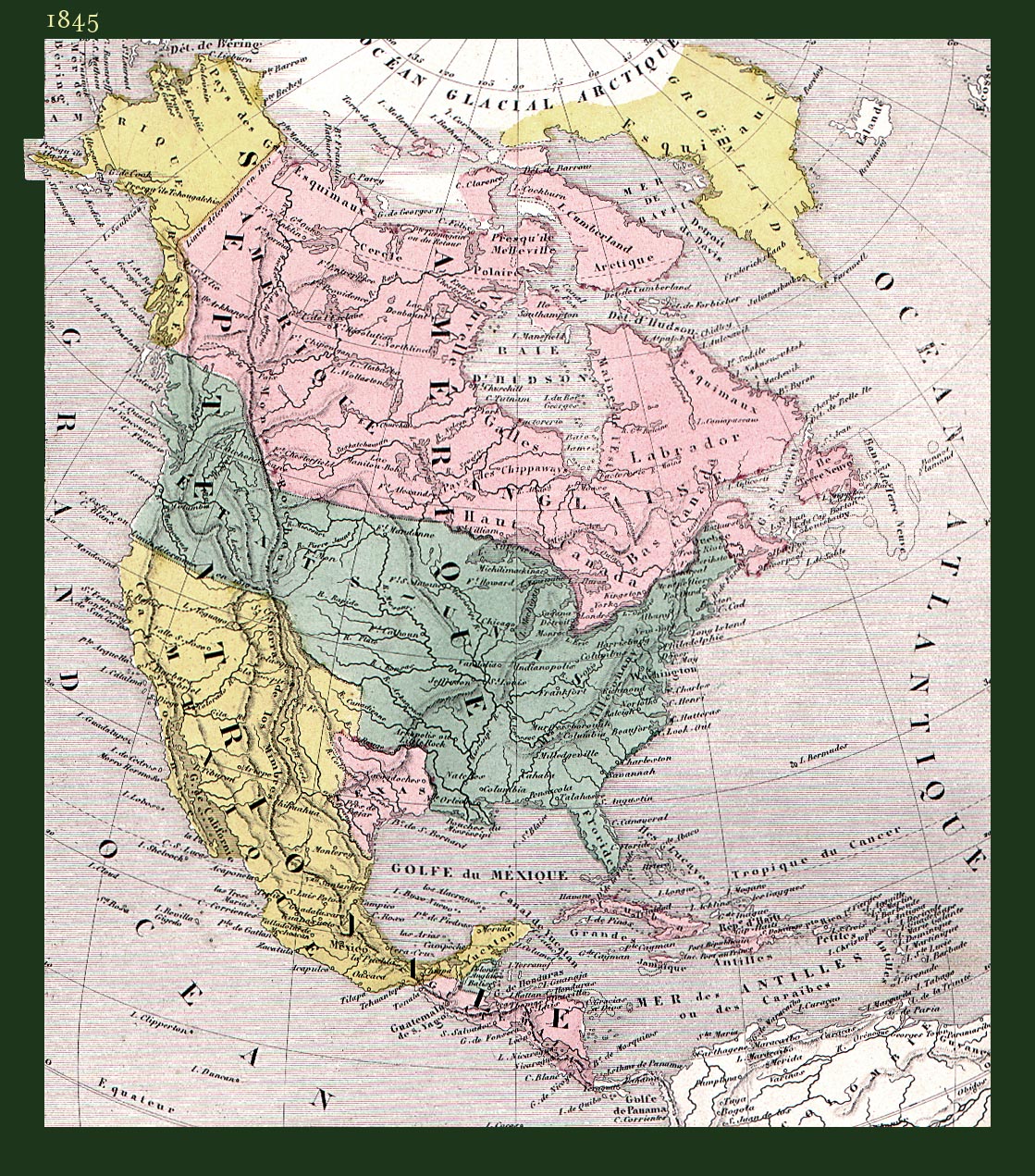
As a visual learner who loves maps, I can picture the shifting political boundaries of the continent in 1609, 1620, 1763, 1776, 1812, 1845 (below right; a beautiful reproduction of a French map from the USGenWeb site), 1900, and 1912. Despite all of these changes, some less than a century ago - I think that the way things are now is the way maps will continue to look.
I'm thinking about this - permanence, change, and my self-indulgent belief in the inevitablity and permanence of the extant - as I've just finished reading The Dominion of War: Empire and War in North America, 1500-2000. The shape of things now was not pre-ordained; of course not. A bullet a bit further to the right and Washington would have been killed in the Battle of Monongahela; the U.S. could quite conceivably have been three nations, or five with one German-speaking, or none; Pittsburgh and Chicago could have deep French roots and a francophonic minority well into the 20th century, along with New Orleans; all could be French to this day.
At a thousand - a million - different points in history, a man or woman could have made a different decision and the trajectory of the future would be significantly different. This is hardly an original thought - H.G. Wells, Marty McFly, the Simpsons, The Terminator, Douglas Adams, and many, many others, have all played with the same point - but I forget that it applies to my life.
Are there events in my life that will have affects for the next century? What are they?
There is no way of knowing, of course, or if they are happening in our lives. Most of human history has - which means most humans have - plodded along, living and dying, without affecting too much beyond their immediate villages or families. But there are points in the sweep of history when that's not the case. Is now one of those times?
What do we want 200 years from now to look like? What are the givens that don't have to be?
I've said for years - at least since a circa 1997 discussion with my father - that future generations would look back at us with the smug disdain we reserve for Madam Antoinette. Is Bernie Madoff our "Let them eat cake" moment? I've thought and written and wondered for years about the insustainability of our lives and the pace at which we have consumed natural resources, to the point where in 2001 a friend threatened to make me a shirt that said "When your kids don't have any natural resources..." Thomas Friedman wonders, with many others, if this is when we finally stop the depletion?
As a visual learner who loves maps, I can picture the shifting political boundaries of the continent in 1609, 1620, 1763, 1776, 1812, 1845 (below right; a beautiful reproduction of a French map from the USGenWeb site), 1900, and 1912.
 Despite all of these changes, some less than a century ago - I think that the way things are now is the way maps will continue to look.
I'm thinking about this - permanence, change, and my self-indulgent belief in the inevitablity and permanence of the extant - as I've just finished reading The Dominion of War: Empire and War in North America, 1500-2000. The shape of things now was not pre-ordained; of course not. A bullet a bit further to the right and Washington would have been killed in the Battle of Monongahela; the U.S. could quite conceivably have been three nations, or five with one German-speaking, or none; Pittsburgh and Chicago could have deep French roots and a francophonic minority well into the 20th century, along with New Orleans; all could be French to this day.
At a thousand - a million - different points in history, a man or woman could have made a different decision and the trajectory of the future would be significantly different. This is hardly an original thought - H.G. Wells, Marty McFly, the Simpsons, The Terminator, Douglas Adams, and many, many others, have all played with the same point - but I forget that it applies to my life.
Are there events in my life that will have affects for the next century? What are they?
There is no way of knowing, of course, or if they are happening in our lives. Most of human history has - which means most humans have - plodded along, living and dying, without affecting too much beyond their immediate villages or families. But there are points in the sweep of history when that's not the case. Is now one of those times?
What do we want 200 years from now to look like? What are the givens that don't have to be?
05 March 2009
How I chose my college
I went to a private high school, but it’s maybe not what you’re picturing. There were 48 seniors in the Central Catholic class of 1987, and we all had to do something because the school was perpetually broke and required student labor to run. I had a key to the building and would occasionally go in at night to work on the yearbook, to let in a friend who forgot an assignment, to place the drip buckets after a heavy rain or surprising thaw, or to pick up equipment for the basketball team which found itself halfway to Clinton Prairie HS without road unis. We wore gloves in class in winter, and while we couldn’t smoke inside we were allowed to chew tobacco as long as we were “tidy.” If you were nice, occasionally funny, showed up with your homework done most of the time, made an effort and demonstrated concern about performance, then that was enough for an A from many teachers.
While “college” was a given for most of us at CC, “college” was pretty limited: it meant Purdue if you were a math person, IU if you were a lit/humanities person, and Ball State if you weren’t real bright. Notre Dame got about one kid a year, and in my year that wasn’t going to be me. We had no AP classes, no one talked about or had even heard of the ACT, and there were no SAT prep classes – if you broke a thousand you were done. I took the SAT the morning between two Junior/Senior proms. I was done.
It was understood that I wasn’t going to Purdue because I wasn’t a math or science kind of guy. It was understood that I wasn’t going to IU because, well, I was different. I wanted school spirit and somewhere with a good journalism program, and while that sounds a bit like IU I didn’t even consider it. And anyway, I couldn’t have picked a good journalism program out of a burlap sack with nothing in it but good journalism programs. I picked the three colleges I applied to one day in early October, sitting in English class with a stack of college stuff, when I asked aloud to anyone in earshot: “Guys, where I should apply?” My friend Dave said, “You’re asking us? Start with the ones that don’t make you write essays.”
I completed the Marquette app that day and mailed it in. I’d first heard of MU from the sweatshirt my cross country coach would wear sometimes, and I had seen the men’s basketball team play once on TV in the window at Montgomery Ward in the mall (losing in overtime to Notre Dame). I asked my dad about it and he said, “Yeah, it’s a good school. It’s not Catholic, though, it’s Jesuit.” I didn’t get that at the time. I applied to three colleges – Catholic U., where my Dad had gone (’52), Saint Louis U., and Marquette. My acceptance letter to MU arrived just after Thanksgiving – I’ve kept it – and it was dated on my birthday, 1986.
My ma had a cousin in Milwaukee and I had one excused-absence college visit day left from CC, so she said to me “Why don’t we go see Sr. Mary Calvin in Milwaukee and you can tour Marquette?” I liked road trips, so even though I was pretty set on Catholic U. I made the appointment and we went. My interview was with the Admissions Office intern, a current MU senior from Cincinnati who seemed impossibly polished and professional to me. He met with me solo for 20 minutes and then my mom joined us for the last half. Walking out from the interview she said “I could see you doing that,” which was a prescient comment if ever there was one: my office years later would be the one in which we’d met our student interviewer. Our personal tour guide was from Vermont and he wore Birkenstocks, which I’d never seen, and his mellow, neo-hippie vibe was wholly new and wholly seductive, and surprising given the gritty, urban feel of campus. We loved him. I loved the city feel, I loved the Marquette gear on the students, I loved the mix of students and their friendliness – I loved it all. The Joan of Arc Chapel in the middle of campus – built in France in the 1500’s and reassembled in Milwaukee with no pews and a heated flagstone floor on which kids sat for Mass – was a beautiful, peaceful space, and then you walked outside to the rumble of busses and one way streets and the skyscraper 12th floor dorm that I’d likely be living in. This was the downtown of a major American city, even bigger than Indianapolis, and I could be going to school here!
Back in the car pointed south, with the late afternoon sun making Lake Michigan that impossible cerulean blue on our left, the sky punctured by church steeples stretching out for what seemed like forever on our right, and the skyline of Milwaukee in our rearview mirror, Catholic U. didn’t stand a chance. Ma asked “What’d ya think?” and I answered “I want to go to Marquette.”
She didn’t argue. Reading my mind, she said “Tell your father when you get home and he’ll be proud of you. Don’t worry, he only wanted you to go to Catholic if that’s what you really wanted.” She liked that she had a cousin in Milwaukee – even if that cousin was an elderly nun who didn’t drive, she knew I’d have someone to be responsible to and occasionally for – and having endured something similar to this process nine times before she was pretty sanguine. She’d really only made three comments about my post-high school plans: “You’re not going to Chaminade,” when I’d talk about Hawai`i and the time she and dad spent there when he was drafted during the Korean War; “I’m not sure the Navy is going to be right for you,” after I’d had several long conversations with my Navy recruiter, had aced the ASVAB and had talked to my two older brothers who’d served; and “I’m not sure how you’d afford Notre Dame,” when I was told I’d be putting myself through college like all of my siblings before me. (Well, I had the money in my savings account from when Granpa sold a pig on my first birthday, like he had for all of us, but that didn’t cover a year of college like it used to.) She liked Marquette for me, I could tell; she was a go-with-your gut person, and her comfort with the decision gave me additional confidence in it.
So I made a great decision in a sloppy, ill-managed way. I loved Marquette, and still do; when I walk across campus now I still get goosebumps and I tell the students that I work with that I want that for them – that they find their “goosebump” school. Years later after I’d started work in the admissions office I learned that our tour guide from that day had been fired; he wasn’t particularly reliable. That skyscraper that I moved into with such enthusiasm and apprehension in August, 1987, now looks like a squat, dated example of 1970’s architecture, but from my room on the 12th floor I could see all the way to County Stadium, and down the hall from me were guys from Idaho and suburban Los Angeles and Rhode Island and Syracuse, and even one guy from Chicago who didn’t have a driver’s license and grew up above his family’s pub. (I was shocked – people with kids run pubs for a living? He was shocked that I'd help butcher a cow, so we were even, I guess.) I was in classes with a dairy famer’s son and a half Colombian kid from northern Minnesota with an almost impenetrable Min-uh-SOH-tan accent whose dual language was Spanish; there was a girl from Mauritius who spoke French as her first language and had brown skin which wasn’t the color either of the Mexicans I’d met or my sister’s Vietnamese classmate; there was a black guy with an Irish last name, which I hadn’t known was possible. My world was terrifically expanded.
It wasn’t perfect. Marquette was deeply, institutionally anti-gay then, and I learned the courage it took to be out and the changes that coming out could evince, and the gift of supportive allies, and how people will almost always do the right thing when given a chance. There were misogynist faculty members and also priests who would say a gender inclusive Mass in Joan of Arc. There were protests about divesting from South Africa and a new program to feed the hungry in Milwaukee, which is still going strong. It was a majority white, conservative, Catholic college in the Midwest at the end of the Reagan years. And somehow, it was exactly what I needed.
I learned there. I was expected to learn how to think, to study, to work, to be disciplined and to question at Marquette, and I did it; reluctantly at first but I did it. I learned how to ask questions. I learned that when a room number started with a “3” it was likely on the third floor. I learned that wealth and good manners were not correlative. I learned that I wasn’t nearly as smart as I thought I was, or as smart as I’d been told I was, and that smarts didn’t matter that much anyway. I learned that academic excellence required work and tenacity, and that work and tenacity yielded results. I would sit in class some days and it would feel as though rivets were popping in my head as brain was cajoled into expanding to make connections and imagine things that had been until that instant unimaginable. I learned both how to read French and how to shoot pool, and both with flashes of brilliance and long stretches of plodding. I learned about the economic implications of the Bubonic Plague on Europe and of the occasional, unlooked-for $20 my ma would mail me on the Monday Night Club. I read Camus and for getting through it I felt sophisticated for about 15 seconds, and then I felt daunted when I realized I’d have to read it again to wring meaning from it. I learned to see the bottomless fissures of beauty in Shakespeare – fissures which I could not yet plumb, and which made me feel simultaneously vertiginous and humbled, and like I wasn’t learning anything at all. I learned that it was an awfully big world out there.
I had no idea of my potential when I hauled my stuff out of our 1979 Caprice Classic in front of McCormick Hall in 1987, socially, intellectually, or experientially. I learned how to love to learn, and how to be brave. I can’t test the null – what would have happened had I gone to IU or Catholic or Notre Dame? – but that’s not the point. I have some sense of who I was when I started at MU and who I was when I left, and I have no doubt that Marquette was where I needed to be. At different points in my life - riding the subway in Tokyo, or playing cards with Australian friends on a beach in Thailand, or sitting in my graduate class on indigenous politics at UH Mānoa - I’d wonder how a boy from Fowler, Indiana, could be doing this. I usually conclude that it’s because he ended up where he needed to be for college.
I try to remember this when I talk to families, and always to remember why my job is important to me.
While “college” was a given for most of us at CC, “college” was pretty limited: it meant Purdue if you were a math person, IU if you were a lit/humanities person, and Ball State if you weren’t real bright. Notre Dame got about one kid a year, and in my year that wasn’t going to be me. We had no AP classes, no one talked about or had even heard of the ACT, and there were no SAT prep classes – if you broke a thousand you were done. I took the SAT the morning between two Junior/Senior proms. I was done.
It was understood that I wasn’t going to Purdue because I wasn’t a math or science kind of guy. It was understood that I wasn’t going to IU because, well, I was different. I wanted school spirit and somewhere with a good journalism program, and while that sounds a bit like IU I didn’t even consider it. And anyway, I couldn’t have picked a good journalism program out of a burlap sack with nothing in it but good journalism programs. I picked the three colleges I applied to one day in early October, sitting in English class with a stack of college stuff, when I asked aloud to anyone in earshot: “Guys, where I should apply?” My friend Dave said, “You’re asking us? Start with the ones that don’t make you write essays.”
I completed the Marquette app that day and mailed it in. I’d first heard of MU from the sweatshirt my cross country coach would wear sometimes, and I had seen the men’s basketball team play once on TV in the window at Montgomery Ward in the mall (losing in overtime to Notre Dame). I asked my dad about it and he said, “Yeah, it’s a good school. It’s not Catholic, though, it’s Jesuit.” I didn’t get that at the time. I applied to three colleges – Catholic U., where my Dad had gone (’52), Saint Louis U., and Marquette. My acceptance letter to MU arrived just after Thanksgiving – I’ve kept it – and it was dated on my birthday, 1986.
My ma had a cousin in Milwaukee and I had one excused-absence college visit day left from CC, so she said to me “Why don’t we go see Sr. Mary Calvin in Milwaukee and you can tour Marquette?” I liked road trips, so even though I was pretty set on Catholic U. I made the appointment and we went. My interview was with the Admissions Office intern, a current MU senior from Cincinnati who seemed impossibly polished and professional to me. He met with me solo for 20 minutes and then my mom joined us for the last half. Walking out from the interview she said “I could see you doing that,” which was a prescient comment if ever there was one: my office years later would be the one in which we’d met our student interviewer. Our personal tour guide was from Vermont and he wore Birkenstocks, which I’d never seen, and his mellow, neo-hippie vibe was wholly new and wholly seductive, and surprising given the gritty, urban feel of campus. We loved him. I loved the city feel, I loved the Marquette gear on the students, I loved the mix of students and their friendliness – I loved it all. The Joan of Arc Chapel in the middle of campus – built in France in the 1500’s and reassembled in Milwaukee with no pews and a heated flagstone floor on which kids sat for Mass – was a beautiful, peaceful space, and then you walked outside to the rumble of busses and one way streets and the skyscraper 12th floor dorm that I’d likely be living in. This was the downtown of a major American city, even bigger than Indianapolis, and I could be going to school here!
Back in the car pointed south, with the late afternoon sun making Lake Michigan that impossible cerulean blue on our left, the sky punctured by church steeples stretching out for what seemed like forever on our right, and the skyline of Milwaukee in our rearview mirror, Catholic U. didn’t stand a chance. Ma asked “What’d ya think?” and I answered “I want to go to Marquette.”
She didn’t argue. Reading my mind, she said “Tell your father when you get home and he’ll be proud of you. Don’t worry, he only wanted you to go to Catholic if that’s what you really wanted.” She liked that she had a cousin in Milwaukee – even if that cousin was an elderly nun who didn’t drive, she knew I’d have someone to be responsible to and occasionally for – and having endured something similar to this process nine times before she was pretty sanguine. She’d really only made three comments about my post-high school plans: “You’re not going to Chaminade,” when I’d talk about Hawai`i and the time she and dad spent there when he was drafted during the Korean War; “I’m not sure the Navy is going to be right for you,” after I’d had several long conversations with my Navy recruiter, had aced the ASVAB and had talked to my two older brothers who’d served; and “I’m not sure how you’d afford Notre Dame,” when I was told I’d be putting myself through college like all of my siblings before me. (Well, I had the money in my savings account from when Granpa sold a pig on my first birthday, like he had for all of us, but that didn’t cover a year of college like it used to.) She liked Marquette for me, I could tell; she was a go-with-your gut person, and her comfort with the decision gave me additional confidence in it.
So I made a great decision in a sloppy, ill-managed way. I loved Marquette, and still do; when I walk across campus now I still get goosebumps and I tell the students that I work with that I want that for them – that they find their “goosebump” school. Years later after I’d started work in the admissions office I learned that our tour guide from that day had been fired; he wasn’t particularly reliable. That skyscraper that I moved into with such enthusiasm and apprehension in August, 1987, now looks like a squat, dated example of 1970’s architecture, but from my room on the 12th floor I could see all the way to County Stadium, and down the hall from me were guys from Idaho and suburban Los Angeles and Rhode Island and Syracuse, and even one guy from Chicago who didn’t have a driver’s license and grew up above his family’s pub. (I was shocked – people with kids run pubs for a living? He was shocked that I'd help butcher a cow, so we were even, I guess.) I was in classes with a dairy famer’s son and a half Colombian kid from northern Minnesota with an almost impenetrable Min-uh-SOH-tan accent whose dual language was Spanish; there was a girl from Mauritius who spoke French as her first language and had brown skin which wasn’t the color either of the Mexicans I’d met or my sister’s Vietnamese classmate; there was a black guy with an Irish last name, which I hadn’t known was possible. My world was terrifically expanded.
It wasn’t perfect. Marquette was deeply, institutionally anti-gay then, and I learned the courage it took to be out and the changes that coming out could evince, and the gift of supportive allies, and how people will almost always do the right thing when given a chance. There were misogynist faculty members and also priests who would say a gender inclusive Mass in Joan of Arc. There were protests about divesting from South Africa and a new program to feed the hungry in Milwaukee, which is still going strong. It was a majority white, conservative, Catholic college in the Midwest at the end of the Reagan years. And somehow, it was exactly what I needed.
I learned there. I was expected to learn how to think, to study, to work, to be disciplined and to question at Marquette, and I did it; reluctantly at first but I did it. I learned how to ask questions. I learned that when a room number started with a “3” it was likely on the third floor. I learned that wealth and good manners were not correlative. I learned that I wasn’t nearly as smart as I thought I was, or as smart as I’d been told I was, and that smarts didn’t matter that much anyway. I learned that academic excellence required work and tenacity, and that work and tenacity yielded results. I would sit in class some days and it would feel as though rivets were popping in my head as brain was cajoled into expanding to make connections and imagine things that had been until that instant unimaginable. I learned both how to read French and how to shoot pool, and both with flashes of brilliance and long stretches of plodding. I learned about the economic implications of the Bubonic Plague on Europe and of the occasional, unlooked-for $20 my ma would mail me on the Monday Night Club. I read Camus and for getting through it I felt sophisticated for about 15 seconds, and then I felt daunted when I realized I’d have to read it again to wring meaning from it. I learned to see the bottomless fissures of beauty in Shakespeare – fissures which I could not yet plumb, and which made me feel simultaneously vertiginous and humbled, and like I wasn’t learning anything at all. I learned that it was an awfully big world out there.
I had no idea of my potential when I hauled my stuff out of our 1979 Caprice Classic in front of McCormick Hall in 1987, socially, intellectually, or experientially. I learned how to love to learn, and how to be brave. I can’t test the null – what would have happened had I gone to IU or Catholic or Notre Dame? – but that’s not the point. I have some sense of who I was when I started at MU and who I was when I left, and I have no doubt that Marquette was where I needed to be. At different points in my life - riding the subway in Tokyo, or playing cards with Australian friends on a beach in Thailand, or sitting in my graduate class on indigenous politics at UH Mānoa - I’d wonder how a boy from Fowler, Indiana, could be doing this. I usually conclude that it’s because he ended up where he needed to be for college.
I try to remember this when I talk to families, and always to remember why my job is important to me.
Subscribe to:
Posts (Atom)