Showing posts with label gay rights. Show all posts

22 November 2014

The Best We Could


It's hard to write about my dad.

It would have been his 84th birthday today, and I've thought about him and our relationship a lot since he died last year. I've kept coming up short when I try to write about him, though, which is as apt as a metaphor for our relationship as any: he and I, despite our efforts, kept coming up short. But upon reflection I've come to realize a couple of other things, too, despite it all: we both kept trying, and we both did the best we could.

And since writing was 
how we kept in touch over the last two plus decades, writing seems apt as the best way for me to remember him.  

I'd try, sometimes, to be in touch in other ways. We had sports (if not many teams) in common, but even then it could be tricky. Baseball players had unions against which he would fulminate, and there were other, unlooked for challenges. One perfect NorCal afternoon, buoyed by the weather on my walk to the bar to watch Indy play a Monday Night game, I called Dad with what I had presumed to be some safe topics lined up. I started with the past weekend's Notre Dame game, but I got "I don't follow them now since they invited that baby killer Obama to campus." Deflated, I quickly wrapped up the call.

He'd try sometimes, too. He'd call and I'd see the caller ID as I sat freezing in the UH library, or while reading or doing laundry or smoking on my tiny back porch in Honolulu or on my roof in San Francisco, and I'd let it go to voicemail. The time difference and our respective travel and work schedules gave us a fig leaf to cover our mutual wariness.

Letters were safer. Writing multiple drafts gave me a chance to see and excise some of my anger and self-righteousness. (Some, though not all, I'm embarrassed to say - some of what I'd written in the letters I found when cleaning out his house made me cringe.) I'm not sure if he wrote multiple drafts or not, but his letters were angry, paternalistic, deliberately hurtful, and often oscillated between the forced-friendly and the furious.

But he read my letters, or at least some of them -- I knew this because I'd hear from those people we had in common that Dad was pleased about a promotion I'd received or a recognition I'd earned. And I read his -- or at least some of them. I learned that a quick analysis of the envelope could reveal something of the tone of its contents. GOP elephant on the return address label and a President Nixon stamp? Likely bombastic, confrontational, and political, with the added bonus of quotes from Rush Limbaugh. A Knights of Columbus or Right to Life return label? Milder but still hectoring, and likely to include quotes from The Catholic Answer or the Pope. A collection of stamps in different denominations (i.e., a 23 cent, an 11 cent, a five cent, etc.)? Likely playful and familial, without anything about the baby killers or how my sinful lifestyle was going to result in my terminal sickness and early death.

He also made copies of his outgoing correspondence. Each of the ten of us had a file, we found, and in mine, in addition to a number of my letters to him, were copies of at least some of his to me. And other things. My folder held funding appeals from organizations like Focus on the Family talking about how "homosexuals" - always "homosexual", never "gay", a convention he followed - were imperiling the moral fabric of America; how crimes committed by these homosexuals were never reported in the press, how homosexuals were pushing their - well, to be clear, "our" - agenda through the godless courts and via the godless Democrat (sic) party. These were all things I'd heard before. They land differently when you hear them from your dad, though.  

I came out to my mom when she was already dying from cancer in 1991. She cried, and we had some difficult conversations about it, but she said that she loved me -- and she also said, "Don't tell your father." I waited a decade, in part with my mom's words in mind, in part because I believed that coming out -- especially to a parent -- should be an act of kindness and not of anger. It took me a while to get there with Dad. And I was nervous about how it would go. I finally decided, when living with my then-boyfriend, to give my dad "the opportunity to do the right thing" as I'd put it to myself and my friends. Wanting us to have a more honest relationship, if nothing else, I came out to him. In a letter.

It didn't go well. 


First the questions: was I gay because he had traveled so much for work and was an absent father when I was growing up? Was I gay because my mom had a strong personality? And my favorite: was being gay why I was no longer a Notre Dame fan?  

And then the statements: your sinful lifestyle will result in your early death, due to HIV/AIDS. You shouldn't work in education because you'll molest kids and infect them with your sinful lifestyle. Don't come home unless you come alone, and only then if you have pre-approval from siblings so they can keep their kids away from you if they choose to. And then, after about a year of this, another letter with this question: did I become gay because I'd been molested by a priest? Dad wrote that he had been: a Catholic Brother molested him when he was 13, and "...let's face it, at that age, pretty much any sexual contact is pleasurable." I was deeply shocked, even though it's all too common a story. I just ached for him -- it broke my heart, and pulled back a curtain to reveal so much. I'd never known that, and I doubt if he'd told anyone else. Ever.

What effect had that trauma had? Survivors of untreated sexual abuse often suffer long term effects -- what had he suffered because of this? What had this introduced into his personality? How had this warped what was there? Had he ever talked about it? He never mentioned it again and never answered any questions when I asked about it. I'll never know.   

We never have a complete understanding of someone else -- we can't, it’s always imperfect -- and I'd aver that most of us don’t have a complete understanding of ourselves. I hope that this knowledge about my dad's journey made me less angry, more patient, gentler. I like to think it did, when I brought it to mind, and for a couple of years I thought of it often. 

Despite his towering temper, after I was nine or so he never hit me, and I remember the spankings I got as a kid being forewarned and a result of my actions. We never went hungry - none of the 12 of us - when we were under his roof. He worked impossibly hard - long days, many nights, many business trips to El Dorado, Arkansas, of all places - to make that happen. He never drank, ever: I saw him have one beer, once, before I graduated from high school. He never swore, ever: I heard him swear only once, after a storm destroyed the roof, the siding, and every pane of glass on two sides of our house in Fowler, and then it was a simple, exhausted, "damn."

But it wasn't easy. Through his illness and death I've been surprised by others' recollections of my dad: a cousin mentioning in passing how he was intimidated and nervous around him; a brother I'd always thought of as a favorite of his recounting Dad’s petty and mean-spirited bullying; forgotten letters from my mom telling me not to take his anger to heart. I took comfort in these recollections. It wasn't just me. From the available data, it was just dad.

And I'm sorry to say that I didn't help matters as much as I could have. I knew how to push his buttons, and I did - certainly in some of my letters to him, but also in person. Some small part of that might have been healthy since so many people tiptoed around him, a learned response to his bullying, and after all, what did I have to lose? I was never going to meet his expectations unless I signed up to be a priest; since I was gay I was beyond the pale, I had tremendous freedom from his opprobrium. In one letter, asking after his recovery from a car accident, I didn't stop myself from asking if he was getting his pain med prescription filled by sending his housekeeper (which he didn't have) to a parking lot with a cigar box (which he didn’t smoke) full of cash like his buddy Rush Limbaugh had. Like many of his generation he was notoriously tight -- even though one of his sons was a builder and submitted a bid to build his retirement home, he went with the guy who submitted the lowest bid. When I went to the house -- before I came out to him and was thus effectively banned -- I’d eyeball a wall and asked if he’d paid extra for its pronounced warp. When he was showing a group of us the blueprints for this house before its construction, he pointed out where the pool table would go in the basement. I looked at the drawings and said "I'm no expert but it looks like something's missing - where's the change machine?"  

I remember many instances of his support when I was a child. He drove me and a friend down to Tennessee one weekend when we were doing research on Confederate POWs who were captured at the Battle of Fort Donelson who were housed -- and died -- in Lafayette during the Civil War. He encouraged me in Scouting and came to a troop meeting to show the other kids how to carve leather work, and even though I had no real skill at it, he encouraged my interest in his hobby as well. He helped me anytime I needed it with homework whenever he was home, no matter how tired he must have been, without a word or gesture of complaint that I remember.

In fact I never heard him complain - about work, or his hours, or anything. (The Cubs, sure, but that's like distant cicadas buzzing on a summer night - part of life for many in the Midwest.)  He put his head down and worked hard, very hard, as a matter of pride, and expected that we all would, too. At many points in my life I've stopped and thought, "When Dad was my age he had to provide for x children." It was never a small number, and it was always nearly viscerally daunting.  

When I was a kid on Sunday mornings he'd get me up at 5:30 to do the paper route around Fowler, which we'd finish in time for the 7 o'clock mass, then come home after church and make waffles from scratch and play hours-long military strategy games, just he and I, until everyone else got home from church.  When I was in the 5th grade he took the day off - something he almost never did - and we rode a bus up to Chicago to see Pope John Paul II say a mass in Grant Park, just he and I.  (Well, and about 7 million others.)

I don't know when or why we began to drift apart. I hit adolescence and began to rebel, though it was nothing like what he'd been through with my brothers: I didn't smoke, flout rules, or show any signs of being counter-cultural. I served daily 7 AM mass intermittently through high school and was a devout Catholic - to the point that I fought with a church youth group leader to make sure we could attend mass on a weekend camping trip - but still, Dad and I drifted apart.

By the time I got my ear pierced my junior year in college we weren't on great terms. I'd timed the piercing so that I could take it out before I came home for Christmas, but mom was sick with a vague but worrying malady so I came home for Thanksgiving with a fake gold stud in the hole so it wouldn't close, though I knew that hell would likely break loose. It did. That was it. He didn’t speak to me for a few months.  I stayed in Milwaukee and worked over Christmas break; in February I only learned Mom had been diagnosed with an aggressive cancer when I called a brother to bitch about my course load and he asked me how I was doing with mom's news. And after mom died that November, quite understandably, grief subsumed him.

He had a car accident and broke his back two years ago, and each of us ten kids took turns going to spend time with him to help his convalescence.  I was nervous about my week there, but honestly it was good. He was still mostly lucid, and I asked him about family stories, about his siblings and childhood, about my mom. We didn't talk much about me, and we certainly didn’t talk about anything in my life after I turned 22 - he didn't ask and I didn't offer - but we had time to be together, and I got to thank him for all of his effort and hard work.

Before that week I looked back and thought about my father's life, and I tried to understand the stress he must have felt about money, the shame he may have felt at taking charity the years we qualified for government support and the kindness of neighbors, the never-ending fatigue that he must have had so often so deeply in his bones. I thought about how the abuse that he experienced from a member of the Church might have contributed to his extreme rigidity, or his temper, or his emotional paralysis.

And I realized, painfully, that I could have done better. I could have been more mature, more thoughtful, and kinder in my letters; I most assuredly could have connected more often. I could have more often let sleeping dogs lie and not comment on something in a vain and futile attempt to make or score a point.

But there was a context for these actions and reactions, for both of us. If we were petty and churlish, easily offended or bullying -- and we were, both of us, all of those things -- well, we're human. In the end, we didn't act from malice. And, in the end, critically, we made the space -- and took advantage of circumstances -- to arrive at something like détente before he died. And in the end, that's enough; it has to be, but it is.

And at the end, here’s what matters: we did the best we could.
.

12 September 2012

Home at home?

A few years ago when living in Honolulu, my ex Arnold would come out to stay with me from time to time.  At first we'd do the tourist things but after a while his visits became less about seeing stuff and more about experiencing O'ahu like the locals - going to my favorite haunts, hanging out with some grad school friends, hitting the beach, going holoholo in town. 

Arnold is Filipino, and one night out at the club a real lokal bruddah comes up and starts talking to us.  Well, to him.  In pretty full-on pidgin. Arnold had no idea what bruddah was saying, so he looked at me.  I translated and responded, looking at bruddah.  Bruddah looked at me, confused, faced Arnold, and asked another question.  Arnold, confused, looked at me.  I translated and responded looking back at bruddah.  Bruddah, confused, nodded and turned again to Arnold and said something else.  It just didn't compute that me, one ha`ole, was in this context the "local" and was the one who could understand a little pidgin; or that Arnold, by now very tan and local looking, couldn't speak or understand a word. 

As that visit was winding down I asked Arnold how it had gone and how he was liking Honolulu. He loved it, of course - most people do - but then he added something that I've thought of often over the intervening years: "I've never felt so comfortable in my own skin." 

He had shared with me some stories of being bussed growing up, from his very diverse West Long Beach neighborhood to very white Wilson HS on the east side. He had told me about being called "Cambo" at school, meant pejoratively and as a reference to the thousands of Cambodians who had settled in Long Beach after the "boat people" exodus from Indochina of the mid 70's.  He never said these things with any particular rancor or bitterness but it had been part of his experience, and now when he told me that being in Hawai`i was comfortable in a way that he'd never experienced before, I remembered them. 

The following year I spent a summer in Thailand for work with a couple of professors from UH.  We were in Chiang Mai and I was taking full advantage of being there - we worked in a hermetically sealed, over-air-conditioned conference room every day from 8 to 5 (or 7 to 7 by the end of the workshop), but we had weekends off and I some time to go exploring.  I fell in love with the food, the pace of life, the people, the steamy climate, pretty much everything, and I contemplated arranging my life so I could live in Asia - feasible? Worth pursuing? As I was idly thinking about it out loud over dinner one night, one of my professors counseled against it.  She was of Indonesian descent, and said that she always loved coming back home to Hawai`i, to the familiar, to a place where she didn't stand out and where she could really be at home.  She asked if I wouldn't get fatigued always being the outsider in places where my appearance meant I wasn't a local and never could be.  I made a comment about how it didn't bother me the two years that I lived in Japan, but how I'd never really thought about it like that. 

I thought about it after she asked me, though, and I thought about not having needed to have thought about it before.  When Arnold first told me about being a bussed-in minority kid in high school I was sympathetic but I didn't get it; when he told me that he felt comfortable in his own skin in Hawai`i I thought smugly, for a split second, that I was above that feeling or awareness of race.

I shouldn't have, because I'm not. At all. I'd been aware of race in Japan - I wasn't being totally honest when I said that "it didn't bother me" when I lived there.  I was a guest in a foreign country on a contract for a finite amount of time, so of course it was very different to what Arnold may have felt as a 9th grader on a school bus being driven across town, but I felt it. Like the time on the train, exhausted and stinky after 14 hours of travel back home to Nagoya from Thailand, when a Japanese business man in a suit sat across from me in the carriage and made no pretense of not openly staring at me. I watched him watch me for a few minutes and then I made a big show of taking out a borrowed old school 35mm camera and squeezing off a couple of shots.

I'd been aware of race in Hawai'i, knowing that no matter how long I stayed or how much language or culture I learned I would never be as local as Arnold would be just by stepping off the plane; that bruddah would speak pidgin to Arnold even though he didn't understand and even though I was standing right next to him, replying. 

And then I thought about white privilege: I'd never had to feel or been made to feel a sense of displacement in my hometown like Arnold had, but more than that, growing up white in Benton County, Indiana, meant that I got to think about race differently than my friends of color, of whatever color. How that meant that I didn't have to think about race at all. I remembered watching my ex Gabriel be stalked around a store in the mall in downtown Columbus and think "Holy shit, that really happens!" How I would hear a jackass in a bar tell my Wisconsin-born Asian friend that his English is really good and think, "Holy shit, people really say that!"  How my ex- Joe, after asking about a restaurant shortly after moving to Georgia, was told by a black neighbor that, "No, 'we' don't go there," as she rubbed an index finger over the skin of her arm.  

So I don't get to be smug - or to be anything - about how someone else feels in his or her own skin, and I'm embarrassed that I was.

But I've thought of Arnold's comment in another way since I've moved from the Bay Area back to SoCal. I hadn't realized that I'd never felt as comfortable in my own skin as when I lived in San Francisco until I'd left it. I was queer in a place where queerness was unremarkable and nothing that needed be commented on - queerness just was. Perhaps like being Asian just was for Arnold in Hawai`i. Like being white in Benton County just was, or being Japanese in Nagoya. I hated the weather in San Francisco, and the prices, and the insufferable smugness that techies can mount. (Yes, we get it, you're really, really special.) I hated walking over that goddamn cliff every night to go to the gym. I hated running my furnace every night in June, July and August. (And careful BLC readers may remember how I hated Palo Alto.) 

But even though I only lived in The City for a year, I grew accustomed to a baseline of queerness. I didn't have to do the work that needs to be done in other places; I didn't need to do the daily coming out, educating and revealing straight privilege that other places may require. I got very comfortable. Not everywhere in The City - I have queer friends who won't go to the Marina, and I was gay bashed by two guys in SoMa and had the bruised ribs to show for it, so I am not saying it's perfect, by any stretch. But in my daily life I was surrounded by queerness and I was the beneficiary of the consciousness-raising of all of the brave queer folk who came before me, and of the commitment to real equality by innumerable allies. I grew to love San Francisco as a special place that felt queerly homey that I didn't fully appreciate until I'd left. 

So I'm sorry that it took me a while, Arnold, but all these years later I'm finally starting to get it - what that feeling of being at home in your skin feels like. And I'll look forward to getting it back.
.

02 June 2010

Letter to the Editor, SF Chronicle, 2-June

In its entirety.


The day I really knew Harvey Milk's legacy
Harvey Milk Day was officially celebrated, to my mind, profoundly on May 19 on the 8:40 p.m. Caltrain heading south, overhearing the conversation of two young men as they entered the bike car at the Redwood City station.

They were engaged in conversation as they entered, appearing well groomed, intelligent and most of all straight, from all appearances, until I overheard one say that he has a cousin who lives in San Francisco, on Valencia Street, near a restaurant. This young man's next words, expressed in the most nonchalant manner, were that he had eaten dinner at this restaurant with his boyfriend.

Milk's vision inspired equality, living on in this young man's free expression of himself that everyone could overhear. Harvey Milk Day, officially celebrated on May 22, had come early, on the Caltrain, in that bike car, within that young man's conversation.

Happy birthday, Harvey Milk, for this young man and all those expressing their freedom with a natural pride instead of having to hide.

Donald Howard, Palo Alto

01 June 2010

So, this is nice...

I've been thinking a lot about the closet over the past few days - how it warps people, how it diminishes them, how "the closet is a cold, lonely place that makes you lie again and again to those closest to you and always risks ending in tears," as Graham McKerrow put it.

People can grow comfortable with it, and "people" includes those who put themselves in as well as those who expect others to stay there. People like John McCain ostensibly speaking for the US Military; the Catholic Church which has been running its own "Don't Ask Don't Tell" shell game for a few centuries now; and countless parents, to name a few.

My dad has other queer children - out of the ten of us, that's not too surprising - and one other sibling has self disclosed to me, so it's not conjecture that they (sic) are queer. But because they haven't told Dad, they are welcome in his home with whomever they want to bring. I, and this likely is not a surprise, am not.

I could have stayed in the closet and thus have been able to bring anyone I wanted to family reunions - even the person with whom I have chosen to spend my life. We could whisper behind Dad's back, me and "the cool siblings," the ones I would tell, and it would all be wink-wink, nudge-nudge, and my personal integrity would be shot to hell for the sake of not aggrieving a bigoted man's prejudices.

I would be ceding permission to determine my integrity. I would be acceding to someone else passing judgment on the quality - not even the quality, but the very validity - of my relationship, of my love.

Why would I do that? How could I do that? I couldn't. Too much Thoreau, maybe, or too much Shakespeare or Whitman or Joyce or even Catholic teaching:
Deep within their consciences men and women discover a law which they have not laid upon themselves and which they must obey... Their dignity rests in observing this law, and by it they will be judged.
So I followed "this law that I discovered" and I came out, and incurred the opprobrium of some family and friends and faculty, because I didn't want "to lie again and again." Ultimately, coming out means telling the truth about your own life. It's being authentically yourself.

The person who stays in the closet must carefully, obsessively, maniacally construct and maintain a façade. He or she may lose themselves in the construction and in the artifice, until there is no longer any there there.

Which brings me to the news item that made me reflect on this again. You'll be glad to know that California State Senator Roy Ashburn, R-Bakersfield, was referenced under this headline: "Outed lawmaker easing stance against gay rights."

(Well, was he outed, really? I don't think so. You may remember the State Senator from a previous post here, where he got busted for DUI after leaving a gay club with a male companion - so I kinda think the Senator outed himself.)

In any event, the article states that the Senator is re-thinking his stand on gay issues, and has declaimed as much from the floor of the Senate.

Well, better late than never, and there is one fewer miserable bastards in the world. According to State Senator Leland Yee, D-San Francisco, was quoted as saying his long-time friend and colleague "Seemed happier now."

Of course he does. He has now begun - sloppily, publicly, and criminally, but we all start somewhere - to live an authentic life. I wish him well, and hope fervently that he spends the rest of his time in the Senate working to undo some of the spiteful and small things he did in the past.

Finally, the Chronicle article cited a Bakersfield Californian article (that I couldn't find) quoting Sen. Ashburn as saying that he had begun "taking care of a lot of old baggage." Too bad that Rev. George Reker's "rentboy" can't help him with that kind of baggage.

Welcome, Senator. It gets easier from here.
.

30 May 2010

Just come out, already (UK version)

The Liberal Democrat Chief Treasury secretary, David Laws, has resigned in the first scandal to buffet the UK's new coalition government.

Laws was meant to be the "hatchet man" of the coalition, cutting huge swaths of government spending. The Conservatives trusted him to do it, and the Lib Dems trusted him to do it as humanely and reasonably as possible. Some on both sides are saying that he's irreplaceable, and that this strikes a deep blow to the coalition.

What did he do that was so wrong?

From the Guardian story:
Laws, a former banker, felt obliged to quit on Saturday after it was revealed he claimed £40,000 in rent expenses from the Commons authorities to cohabit in a property owned by his secret partner, James Lundie. He is understood to have considered quitting as an MP as well.


That's a lot, forty thousand quid, and it sounds bad. BUT - had he come out and said that Mr. Lundie was his partner and/ or taken the mortgage out jointly, he'd've been entitled to MORE. It was £40,000 (~US$60,000) over eight years, or about £750 (US$1100)/ month.

Not nothing, of course, and rules are rules, and as the hatchet man who was likely going to have the single biggest role in new government in cutting money from the budget - to education, to health care, to the disabled, to seniors, to jobs programs - he had to be above reproach and couldn't have been seen to have been feeding at the public trough.

But he didn't need the money, and he wasn't lining his pockets - again, the amount over which he has resigned is less than if he and his partner had put their names jointly on the lease.

So why not come out, declare the relationship, and claim the money legitimately? The Liberal Democrats are the most progressive of the three parties in the UK, so he would have felt no pressure from that quarter. Again from Michael White's piece, "It's not a big deal at Westminster any more, nor in most constituencies, I'd wager, unless it's a big deal to the individual for a host of reasons – most of which are none of our business."

Do people have the right to remain in the closet? Yes.

Should they? Well, clearly they do, and without being in Mr. Laws' shoes I cannot speak for him or speculate as to the "host of reasons" he may have had.

But he was independently wealthy, he was a rising star in a rising party, he had access to nearly every lever of power that can protect a man from anti-gay animus, and he still chose not to come out. I hope he reads the case of the two gay men sentenced to hard labor for 14 years in Malawi for being gay and can draw some courage from them.

Come on, people - don't be afraid. In the west, in the UK, for people of power, wealth and position, it's far better to be out than in.

The government has been damaged - and there is unanimity on that point, from the Times to the Independent to the Sun - and it is damage that could have been avoided had one minister come out.

.

17 May 2010

Portugal gets gay marriage


If I had asked you twenty years ago to name the first six European coutries to extend marriage rights to gays and lesbians, would you have put Portugal in the mix?

Me neither.

Norway, Sweden, Finland, Denmark, Iceland, and the Netherlands would have been my picks, and Catholic Portugal woulda been way down the list somewhere around Spain and Malta, but the whole Iberian Peninsula* now has gay marriage. Portugal is the sixth European nation to decide that "Separate but Equal" isn't and that all citizens should be extended all rights. (And in case you have travel plans, the other five are: the Netherlands, Belgium, Spain, Norway and Sweden. I was close.)

The coolest thing? It became law over the signature of the center right president, Anibal Cavaco Silva, just three days after the Prada-wearing Papa Nazi, Pope Benedict XVI, paraded through in all his fancy robes and told them not to do it. President Silva, unlike Fr. Wild at Marquette, didn't cave to ecclesiastical pressure in a non-ecclesiastical issue and signed the bill that had been passed by the legislature in January.

Portugal is 90% (nominal) Catholic, and this current Pontiff has made maintaining Catholic Europe's orthodoxy and fidelity to Church teaching a key component of his papacy. And by orthodoxy, of course, the Church fathers mean on groinal issues. No women priests, no legalized abortion, restrictive laws on divorce, and certainly, beyond a doubt, no acceding to legal recognition of queer relationships.

Good luck with putting that cat back in the bag.

Of the nations at the bottom of the table for birth rates, for example, are 90%+ Catholic Italy (219 out of 221), Austria (215), Monaco (207) and Spain (197); the bottom quarter of countries and territories on the table is heavily Catholic. I don't think it's that hetero folks in these places are having less sex - I think it's that hetero folks in these countries are deciding that they can exercise some control over their own bodies; that women are deciding that they are not units of baby-making production; that it isn't AD 1636; that the Church is simply wrong on this issue, and intractable for no good reason.

And the more the Church harps on groinal issues which go against what is rational and empirical in their daily lives, the more Western Europeans - and Cubans and Puerto Ricans and Québecois and millions of others - realize the Church is wrong about other things as well. Like, well, gay rights. And intractable about being wrong for no good reason.

So Portugal, Catholic Portugal, has marriage equality now. Along with Catholic Spain. And Catholic Belgium. This would have been unthinkable twenty years ago, but by refusing to learn the lessons of Europe's greatest gift to the world, the Enlightenment, and refusing to accept or accommodate them, the Church is in danger of making itself irrelvant in its historical heartland.

So maybe it's time for the Church to pack up and move back to the Mideast, from whence it came - less need for rationality there, and more zest for following superstition and persecuting others (women, queers, Jews, those who believe in different made up superstitions than you). It could feel right at home!

Just leave the billions worth of art and music made for you. And thanks for Chartres, anyway!

*Except, of course, for Britons on Gibraltar.

10 May 2010

Et tu, Marquette?

(Or as a friend put it to me: "MU blah, blah.")

In grad school at the U of Hawai`i I found far more dogmatism than I found in my undergrad at conservative, Catholic, Jesuit Marquette. At UH there were simply ideas that were off the table, or that were considered too inflammatory to discuss.

At Marquette? We talked about reporductive rights in one of my very first classes on campus, Phil 050. I was shocked. I knew the Church's position, and here we were talking about other ideas and viewpoints. Here were people who thought a woman had a right to choose whether or not to end her pregnancy! I was shocked - I'm not kidding, I'd never met anyone who had espoused that viewpoint before. And while it was a minority opinion in that classroom, it was discussed and considered and people who thought differently from you were treated with respect, even as you disagreed with them.

I learned about academic freedom, and that one of the things that the Jesuits held dear was that there must be a free exchange of ideas for there to be education - not training, but real education - to happen.

MU didn't always live up to its lofty ideals. One chilly morning in 1989 I was stunned when I realized what the maintenance workers were doing with a high pressure hose outside LaLumiere Hall - they were pressure washing the sidewalks. Someone had gone around campus the night before and had chalked "Gay is okay" at various points around campus.

Chalked.

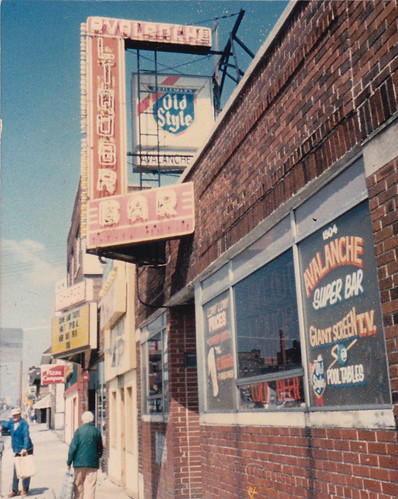
At that time, chalking sidewalks was done by nearly every organization on campus - advertisements for happy hours on Wells Street; study abroad meeting notices; campus ministry volunteer opportunities - they were all broadcast by chalk. (There was no email or texting or cellphones then, remember, so groups had to chalk boards or sidewalks to get news out.) In Milwaukee in the spring, they'd last a few days and then it would inevitably precipitate in some form and there was a tabula rasa for new notices ready and waiting. And there had never been any movement by anyone at the school to wash anything off before. It had been okay to tout 50 cent tappers at the 'Lanche, Ladies night at O'D's, frat parties and poster sales at the Union.

So why was the University power washing sidewalks to remove "Gay is okay"? I was stunned. And went home and thought about it, decided it was illogical, wrote a letter to the Marquette Tribune, and started coming out by showing my letter to one of my roommates and asking his thoughts.

All this was in my mind on Friday when our alma mater got mentioned in the NY Times. Not for great undergraduate education, however, or professorial research, or even for men's basketball, but for discrimination.

As reported in the NY Times and in more depth in the Journal Sentinel, Dr. Jodi O'Brien, a soiciologist and professor at Seattle University, was offered a position at Marquette University to be Dean of the College of Arts and Sciences, accepted the offer, and then had the offer rescinded after intercession by the President's Office.

Dr. O'Brien is an out lesbian who did nothing to hide her orientation during the interview process. I don't know how she could have, given her scholarly writings. The search committee made it an explicit point that she was lesbian. From the Journal Sentinel:

Psychology professor Stephen Franzoi, who served on a search committee for the post, said faculty members forwarded two candidates to Marquette President Father Robert A. Wild and Provost John Pauly. In their recommendation, committee members warned Wild and Pauly not to pick O'Brien if the university was not willing to support her if her sexual orientation or if her scholarship were criticized, Franzoi said.

So now Fr. Wild, who has done a ton of good work for Marquette in moving the institution beyond some of its more shameful past and positioning it as a place that's affirming of GLBT students, says, effectively, "We didn't read her work closely enough and she's anti-family"!?

First, this discriminatiion has a personal side, as discrimination always does. The woman at the heart of the story, Dr. O'Brien, was offered a significantly bigger job, across the country. Have you ever had that experience? I have - it's exciting! You look at neighborhoods, you tell loved ones, you look at cost of living calculators, you start planning all of the thousands of details that go into a move like this. You give your landlord notice or you put your house up for sale; you make an announcement at work; when is your last day and when will be your first, and if you can afford a vacation in between; you wonder if it's the right thing to do. You wonder who's a good dentist, where the bus routes go, who has a decent cup of coffee... it's exciting and stressful and becomes all-consuming.

This woman, it now looks like, will be staying in Seattle at least another year, with colleagues who know she was looking and had an offer. Awkward at best. She has a secure position so unlike the thousands and thousands of queer Americans who are discriminated against every day in this country, she won't be out in the cold - but she had in her hands an offer for what was likely a significant salary jump, and she had it pulled from her. How must that feel? I'd be enraged, insulted, and on the phone with a lawyer.

What about MU? What had they hoped, with this decision? Everyone on campus is now talking about discrimination, everyone is thinking about the role of queer folk in the life of religious institutions, the campus is being engaged in discourse about the visibility of queer folk, how to live up to the official University position of Cura Personalis.

A university is an open place, a place for ideas and discourse and for all ideas being on the table. A Jesuit university, at its best, is a place where everyone can engage in the conversation and at which every idea can be examined, held up to scrutiny, weighed and debated and evaluated and tested.

MU at its best truly educated me. I can only hope this ham-fisted, clumsy attempt to disregard its intellectual heritage and to turn its back on a hire that could further help lead it to intellectual excellence will not stick, any more than pressure washing sidewalks did a generation ago.

Marquette knows better, and the resulting conversation may yet prove that to be true. In the meantime, for all those questioning GLBTQ in the Marquette family, now's a great time to have the conversation with your loved ones. And for those of us who are already out, it's a great time to challenge our school to be the best it can be.

And Dr. O'Brien, I hope to see you in Marquette Hall at some point!
.

05 April 2010

Oh, Ricky...

As has been well documented, I have among the world's worst gaydar. In part it's because I don't really believe in it. Implicit in the concept of gaydar, the ability to tell who is or isn't gay, is that there are ways that gayness manifests itself outwardly - that there are tells by the way a person dresses or acts or looks at you or makes out with you... well, that last one, okay, but the rest? Really? What year is it?

After Stevie and I broke up, I had a rebound relationship with this dude Tony. We met at a sports bar, started talking, he lived in my neighborhood, we staggered home together after being over served, I mentioned "my ex-boyfriend, Stevie" early in the night, he told me he thought I was cute, and we took it from there. He later told me "if you hadn't told me I wouldn't have known you were queer." Might have been pillow talk, but I know that if he hadn't told me, I wouldn't have known.

Embedded in me saying this, there's an assumption so opaque that it's almost invisible: by saying that he and I wouldn't have known without telling each other, I'm acknowledging that there is a way to tell, and thus that there can be "gaydar." Further, saying that we needed to tell each other is to make a claim for ourselves to a non-stereotypically gay presentation. Our location, speech, dress, way of moving through space, interests we discussed - all placed us outside of "gay" in some way, so that we had to disclose our sexual alignment verbally to claim it. And despite my intellectual efforts against it, I would say that there was some pride - that we "passed" was seen as a good thing, or a better thing than "not passing."

I recognized that temptation to pride early in my coming out process, and I tried to be vigilant against it, recognizing it for what it is: divisive, oppressive, laden with gender normativity and value judgment. The fact is, though, that it takes constant vigilance to resist the temptation and to remain aware of the constant flood of messages that bombard us about gender roles and what is and isn't desirable, and I'm lazier now that I used to be. And in some ways I'm less out today than I was in the 90's in Denver or Chicago, when I wouldn't date someone who wouldn't hold my hand wherever the hell I wanted to, who wasn't fully out, who didn't have an integrated life. I have fallen out of some of the habits of earlier decades, in part because they are no longer necessary, but in part because I'm less cognizant of the need, and less surrounded by people who challenge me.

Shortly after I came out in undergrad I pinned a button on my backpack that read "Don't presume I'm straight" because it used to piss me off - this assumption making and distinction drawing. I wanted to reject the notion that "straight acting" was more desirable, or better, or even a thing, or that because I presented a certain way you felt fine telling faggot jokes around me.

But why am I like this? Is this how I really am, or at some level is my behavior formed by reacting against the straight need to be comfortable with a certain type of gay male, and its artifice?

Stereotype: All gay people are x.
Reaction 1: I'm gay, so I have to be x.
Reaction 2: I'm not x, so therefore I'm not gay. Whew!
Reaction 1 never made any sense to me; I wasn't x. (Who IS really, though? Oh, yeah. That kid on "Glee." And that kid in School of Rock. And every male character on "Will and Grace." And that character when a straight lead needs a gay best friend to help them laugh or shop or pick out clothes. Lazy, offensive, one dimensional depictions of gay men - rich, white, shallow, funny, and femme.)

I can't help but wonder if I love football so much as a reaction to stereotype, and that I let straight people's gay stereotypes define me even in a counter-typical way - in any way at all. I don't think that's the case, but it's impossible to test the null, and it's certainly possible. I've read enough biographies and met enough gay ex-Marines to know that there is a type of gay male who on some level tries not to be gay by doing the most stereotypically un-gay thing he can think of.

And in that pursuit or that action, the power is still ceded beyond himself - ourselves - to those to whom we give permission to determine what is the "right" way to talk, to dress, to move through space. The hegemony of cultural types and normative expectations is just that - hegemonic. By either revolting against it or acquiescing to our role within it, we are acknowledging its presence and power.

But I don't know how to avoid it - it's hegemonic, after all. It's foolish to pretend we live in a vacuum, or that our environment doesn't impact us. So what do we do with the normed expectations that are instilled in us from birth, once we begin to see them? What do we do when we reach adolescence and begin to understand that we don't fit - fundamentally can't fit - our proscribed roles?

As an adolescent I dreamt about playing football, and started watching and going to games every weekend. I started memorizing stats, scores and rosters to talk with other kids about. Why? How informed was that choice to follow football as a gay adolescent? From whence came my motivation? Is it coincidental that it started at the same time as I began to understand my inability to be who was expected of me? Unanswerable, unfortunately.

I think of this while thinking about Ricky Martin.

I was going to excoriate him for his cowardice and express my disappointment in his delay. I thought that maybe he is doing the best he can - but on further reflection, that doesn't pass the sniff test. I don't buy it. I try to be compassionate with my gay brothers (movement, not biological - and I have learned that the experiences of gay men and gay women don't have tremendous overlap, and I don't want to speak here for lesbians) and to be patient with their coming out processes. I know all humans have their own paths. I know that sometimes people come out when they aren't ready and that usually goes badly. I know that some people come out in anger. I know that some men are too weak or too wounded, and they can't by themselves get to a place where they are okay with being gay - they need those they love to make it okay for them.

But I continually come back to: dammit, grow a pair!

I made the conscious decision to come out; I did the work and I paid a price. And people who had the conversations after I did with the people with whom I had spoken had an easier time because I blazed the trail. It was 1988, 89, 90 and 91 in Milwaukee - you don't think it was hard sometimes? Or that when I walked straight people through their questions and their discomfort, for as long as they needed, that it didn't make it easier for those same straight people's little brothers, or roommates, or future co-workers? It was, and it did. And I knew it was a political act when I did it.

I made the decision - scared and after much deliberation, but I made a deliberate, conscious, political decision to tell my friends and then my straight roommates, to tell my mom and siblings and dad, to wear a button on my backpack, to hold my boyfriend's hand when I wanted to, to bring up an ex-boyfriend early in every conversation with a new person in my life so that if they didn't like gay folk we could move beyond it early, to put the pride coalition - made up - on my resume so that anyone thinking of hiring me would know, to come out in interviews and ask if it was a problem, to write about it in philosophy and theology papers, to challenge professors to do better than the lazy characterizations of gay folks they had been using in their lectures, to write letters to the editor of every paper I read when they needed to be written, to demand that the institutions for which I worked extend me equal rights and protections.

Gay people who say, "I don't feel like I have to go around announcing it to everyone," are usually so scared or so wounded that they don't realize how offensive they are being to those of us who are out. And it sucks they feel that scared and have been that wounded, it does. But the reality is that they are contributing to their own oppression by remaining invisible - the straight people who want us to feel like telling the truth about our lives is "flaunting" win, in that case. I try to react from compassion and not from crazy, and I think I usually succeed. But people ceding permission to others for how they live their lives, and people acquiescing to the institutions and power structures that says their relationship with the person they love isn't good enough to be named, are contributing to their own oppression.

And I am unwilling to do that. And I am willing to call you on it when you do that.

Don't those closeted queer folk realize that EVERY straight person goes around announcing how straight they are? On NPR Sunday, a radio announcer on Marketplace Money mentioned her husband, totally nonchalantly, where it was not at all needed for the advice she was giving a caller on purchasing a new car. I'm confident she did so without realizing that it was a political act because for her it isn't - it's so opaque it's invisible, her laying claim to the majority and the power implicit in that straight privilege. They don't even realize they're privileged, most of them. (Just like many males don't realize they're privileged. Just like many wealthy people don't understand the implications and depth of their privilege. Just like many white people - gott im himmel, try to point out to white person that he or she is privileged! And wealthy straight white males? You better have some time on your hands.)

People make a decision about coming out.

I get that some people live in a place where coming out requires a much higher price than what I paid. I don't live in a theocracy where I can be openly discriminated against; I don't work in a state that offers no civil protections for gay folk or where I could be fired for coming out; I don't live in a home where I could be beaten; I don't live in fear of losing my housing; I don't serve in a military branch from which I could be discharged with no pension or benefits. I am incredibly lucky. I know.

But people make a decision about coming out. And Ricky Martin, by waiting until he was pop-culturally irrelevant and until a sea-change on queer issues had occurred in Latin America over the last decade as they grew to be pretty tolerant of queer folk, missed the opportunity to be brave, and to be a leader. He is not someone who had to fear for losing his job, or losing his house, or losing citizenship status or being killed. He was insulated by money and power in a way that made it a small risk. And it's still a risk he didn't take.

And that is disappointing, as it is for people anywhere who still, in 2010, choose to live their lives in the closet. You can do better. Better late than never, but you can do better.

03 August 2009

Open letter to University of Hawai'i-Mānoa's AD

Here's the original incident.

Here's a story on the reaction.

Here's my letter to the AD:

To: athdir@hawaii.edu
Date: Fri, 31 Jul 2009 22:32:36 -0700
Subject: Coach McMackin's comments

Dear Mr. Donovan -

I am writing to express my deep concern and disappointment over Coach's comments at the WAC media day. They were disgusting and have no place in public discourse, but what is more troubling is that his cavalier use of a deeply offensive epithet seems to betray an attitude that has no place at an institution of higher learning.

As gay man I was shocked when I heard it; as an alumnus (MURP '05) I was particularly offended.

I am a sports fan, and as such I have learned that I need to be thick skinned against the stream of comments that I hear while watching a game in a stadium, arena, restaurant or bar. It's commonplace enough in a bar to hear "faggot" when a player drops a ball or a ref makes a bad call, and that's bad enough. I feel it, each time, despite my best efforts. But for a state employee and educator at the state's flagship institution to refer to something that he considered less than whatever his ideal of masculinity may be as "faggot" isn't just unacceptable - it's just stunning.

Insert any other epithet and he'd be gone tomorrow. Think about it - run through them, the worst word for race and gender you can think of, and it makes your skin crawl, doesn't it? A firing in that case would be appropriate. I guess that it's still okay to vilify and denigrate gays in athletics, and that's unacceptable.

Chances are very, very good that there's at least one young man on that team for whom this is a personal affront from a respected leader, teacher, and mentor - and state employee - and there is no question that at UH-Manoa there are gay male athletes. It's not a theoretical insult; it's real, personal and hurtful.

I can't express enough my disgust for Coach McMackin's comments; I can express my real disappointment at my alma mater's reaction.

I hope that the entire Athletics Office takes this as an opportunity to educate its educators on how to comport themselves in public, first - and further how to be real leaders for all students at the University.

I will monitor this story closely and hope to hear that more substantive steps are being taken to ensure that the University of Hawai'i is a safe place for all students, a place where all people are respected, and a place where no one - not even the head football coach - is above the rules of common decency and civility.

Sincerely,
Steve Brennan