05 May 2010
"But Jesus hung out with prostitutes, too!"
This summary is not available. Please
click here to view the post.


03 May 2010
Washed up
I'd bought it to be a beach blanket, and it was already in the trunk. I saw it when I threw my bag in the trunk, my new orange blanket from Ikea with the unpronounceable Swedish name, as I left for school visits in San Luis Obisbo and Santa Barbara. On my way back to LA that day in 1999, I pulled off the 101 in the brilliant afternoon sunshine to hit the beach. 
I took it down to the sand, threw it out, anchored it with my slippahs, and stretched out in the balmy sunshine. At the end of my reading material an hour later, I started to pack up, mindful of when I'd hit LA traffic, and that's when I saw it: big black gobs of goo on my feet! I was shocked - so shocked that it took me a while to realize what the big gobs of black, gooey stuff could be. I scrounged around for a stick and scraped off as much as I could, and then went into the surf to try and get the rest off. But it wouldn't come off! I kept stepping in more, and now as I looked it was everywhere. I'd rub my feet on rocks and with the stick to get the globs off, but my feet were stained, and no matter how much I scrubbed with sand and sea water, and no matter much kept coming off, there was still more. After about 20 minutes I declared my feet clean, but then I noticed my slippahs were covered - so I repeated the process and got as much off of them (new stick) as I could and put them back on, recontaminating the soles of my feet with what I couldn't really get off from the decks of my slippahs. I then shook out my blanket and saw the globs there! I shook out the sand, balled it up and trudged back up to my car, feeling violated.
Later at the Goleta Coffee Company for a post-beach fuel-up, I struck up a conversation with some locals, told them about the tar, and displayed my raw and rubbed-red feet, still stained. They confirmed my suspicions - it wasn't tar, it was crude oil. From a spill off the coast. In 1969, 30 years earlier.
Before I got home I stopped at a hardware store for turpentine, used my t-shirt as a rag to clean up my slippahs and my feet, and tried to get the  worst of it out of my beach blanket. Finally I realized the only thing to do was to cut it out of the material so it wouldn't keep spreading onto other surfaces, so I did (right). My trip to the beach had cost me a t-shirt, a can of turpentine, a few hours of cleaning time, and a hole in my new Ikea blanket. Despite my best efforts, I suspect someone at Avis had a helluva time getting the brake and gas pedals clean.
 worst of it out of my beach blanket. Finally I realized the only thing to do was to cut it out of the material so it wouldn't keep spreading onto other surfaces, so I did (right). My trip to the beach had cost me a t-shirt, a can of turpentine, a few hours of cleaning time, and a hole in my new Ikea blanket. Despite my best efforts, I suspect someone at Avis had a helluva time getting the brake and gas pedals clean.
 All this from an oil spill that happened thirty years earlier.
What's going to happen in the Gulf of Mexico? What's going to be the effect in thirty years on the beaches of Louisiana, Mississippi, Alabama, and yes, Florida and Texas? What's going to happen to the fisheries and shrimp grounds and to all of the people who depend upon them for their livelihoods? I heard President Obama say today that BP is going to be on the hook for the cost, but what cost? In 30years is BP going to pay for a beach-goer's turpentine, t-shirt and beach blanket?
There is simply no way to pay for the costs of an oil spill like the one happening right now 5000 feet below sea level on the floor of the Gulf of Mexico. The costs are incalculable. And until all the costs - ALL the costs - of a petroleum based economy are captured at the consumer level, then we will make irrational decisions about our energy consumption, and keep buying artificially cheap gas and the cars that burn it.
When I pay $3.12 for a gallon of gas up the street at the Shell station, that does not cover the costs of the oil spill in the Gulf of Mexico, or the defense budget it takes to ensure enough supply, or the long term effects that my using that gas will have on a warming environment, or the asthma of a child in Long Beach who is growing up downwind of the harbor and who breathes in bunker fuel exhaust from an ocean tanker bringing in raw crude oil to the refineries in Wilmington.
What is the real cost of a gallon of gas? It's nearly mpossible to calculate.
When President Obama earlier this year signalled that he was going to open parts of Alaska, the Atlantic seabed, and additional areas in the Gulf to oil production, I was deeply disappointed and I thought strongly that it was the wrong policy - but I understood the motivation. What are we supposed to do? We burn the stuff, and we burn more than we have. What are we supposed to do? What's the solution? Use less and switch the hell off of it before we destroy the planet, bankrupt ourselves in favor of some of the worst people in the world, and run out, sure. But even if we all decided tomorrow that was the right course to pursue - and we won't, but even if we did - it will take decades to get there.
When I had that experience back in '99, I was annoyed (and for several days after I kept that tshirt and turpentine handy, as there was a lot of "how did oil get THERE?!") but smug. I didn't own a car, so I was not part of the problem. Never mind that I sure used jet fuel, that I rented a car for work purposes for over half the weeks of the year that didn't run on fairy dust, that I bought consumer goods and foods made all over the world that were flown or shipped in to my local store - I was not part of the problem.
I was wrong then, and my smugness embarrasses me in hindsight. The worse thing is that I'm an even greater part of the problem now. I drive everywhere. My bike got stolen and I almost never take the train anymore, even though it goes to just a few blocks from work. I still fly an awful lot - I'm dating someone in Georgia, for the gods' sake!
I remember feeling a little sick after I realized what I'd stepped in on that beach in 1999, and that it had washed up from thirty years before. I wondered how many decades it would take for that washed up oil to really be "cleaned up." After I'm gone, it's safe to say, is one answer.
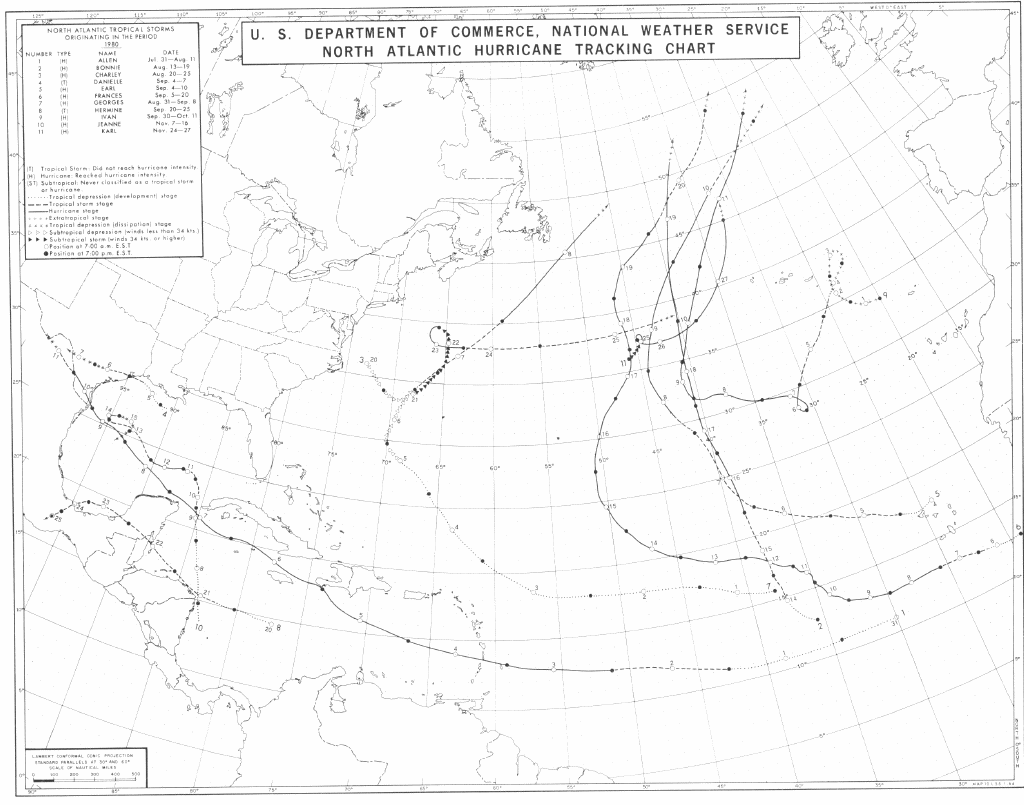
By the time hurricane season comes, in just twenty eight days, with possible onshore storm surges pushing Gulf seawater - and crude oil - miles into the delicate estuaries along the coast, and winds of more than 70 miles an hour lifting Gulf seawater spray and foam - and crude oil - and blowing it miles and miles inland, maybe the spill will have been "cleaned up." Maybe by then the leak will have been stanched, and the 200,000 gallons of crude oil currently shooting into the Gulf everyday from an oil deposit another 18,000 feet below the sea floor will have been greatly diminished, or stanched all together. Maybe it will be a hurricane season like 1980, when no storms hit the current spill area.
But I'm not particularly hopeful.
There's no question that it's the Louisiana and Mississippi Gulf Coast residents who will pay a disproportionate share of the damage, whatever damages turn out to be, and that my $3.12 a gallon isn't going to begin to cover the cost. And all that crude oil, floating on the water - getting stirred up by winds, suffocating even more of the Gulf of Mexico ecosystems - means that a lot more than crude oil is going to be all washed up.
There is simply no way to pay for the costs of an oil spill like the one happening right now 5000 feet below sea level on the floor of the Gulf of Mexico. The costs are incalculable. And until all the costs - ALL the costs - of a petroleum based economy are captured at the consumer level, then we will make irrational decisions about our energy consumption, and keep buying artificially cheap gas and the cars that burn it.
When I pay $3.12 for a gallon of gas up the street at the Shell station, that does not cover the costs of the oil spill in the Gulf of Mexico, or the defense budget it takes to ensure enough supply, or the long term effects that my using that gas will have on a warming environment, or the asthma of a child in Long Beach who is growing up downwind of the harbor and who breathes in bunker fuel exhaust from an ocean tanker bringing in raw crude oil to the refineries in Wilmington.
What is the real cost of a gallon of gas? It's nearly mpossible to calculate.
When President Obama earlier this year signalled that he was going to open parts of Alaska, the Atlantic seabed, and additional areas in the Gulf to oil production, I was deeply disappointed and I thought strongly that it was the wrong policy - but I understood the motivation. What are we supposed to do? We burn the stuff, and we burn more than we have. What are we supposed to do? What's the solution? Use less and switch the hell off of it before we destroy the planet, bankrupt ourselves in favor of some of the worst people in the world, and run out, sure. But even if we all decided tomorrow that was the right course to pursue - and we won't, but even if we did - it will take decades to get there.
When I had that experience back in '99, I was annoyed (and for several days after I kept that tshirt and turpentine handy, as there was a lot of "how did oil get THERE?!") but smug. I didn't own a car, so I was not part of the problem. Never mind that I sure used jet fuel, that I rented a car for work purposes for over half the weeks of the year that didn't run on fairy dust, that I bought consumer goods and foods made all over the world that were flown or shipped in to my local store - I was not part of the problem.
I was wrong then, and my smugness embarrasses me in hindsight. The worse thing is that I'm an even greater part of the problem now. I drive everywhere. My bike got stolen and I almost never take the train anymore, even though it goes to just a few blocks from work. I still fly an awful lot - I'm dating someone in Georgia, for the gods' sake!
I remember feeling a little sick after I realized what I'd stepped in on that beach in 1999, and that it had washed up from thirty years before. I wondered how many decades it would take for that washed up oil to really be "cleaned up." After I'm gone, it's safe to say, is one answer.
By the time hurricane season comes, in just twenty eight days, with possible onshore storm surges pushing Gulf seawater - and crude oil - miles into the delicate estuaries along the coast, and winds of more than 70 miles an hour lifting Gulf seawater spray and foam - and crude oil - and blowing it miles and miles inland, maybe the spill will have been "cleaned up." Maybe by then the leak will have been stanched, and the 200,000 gallons of crude oil currently shooting into the Gulf everyday from an oil deposit another 18,000 feet below the sea floor will have been greatly diminished, or stanched all together. Maybe it will be a hurricane season like 1980, when no storms hit the current spill area.
But I'm not particularly hopeful.
There's no question that it's the Louisiana and Mississippi Gulf Coast residents who will pay a disproportionate share of the damage, whatever damages turn out to be, and that my $3.12 a gallon isn't going to begin to cover the cost. And all that crude oil, floating on the water - getting stirred up by winds, suffocating even more of the Gulf of Mexico ecosystems - means that a lot more than crude oil is going to be all washed up.
02 May 2010
Karl Rove and I Agree
Here's something I'd never anticipated when I started writing BLC: Karl Rove and I are on the same side of an issue. We both agree that bashing illegal immigrants is bad for Republicans.
In a great piece by Frank Rich in the New York Times, Rich writes:
As I wrote in a piece two days ago, Arizona's law could well lead to that state joining the more liberal Pacific states as bedrock democratic electoral votes - as "givens" in presidential elections.
For sure, Arizona will be in play, and the Hispanic bashing xenophobes of the Tea Party and the GOP could deliver other states as well.
Colorado went for Bill Clinton but not for Gore or Kerry - Hispanics helped deliver it to President Obama in 2008. In 1980 it was 12% Hispanic; in 1990, 13%; in 2000, 17%; in 2009 it was projected at 21% - more than enough in a state with strong environmental ethics and white, educated liberals for a strong coalition of Democratic voters to coalesce.
Nevada went to Clinton twice and then for President Bush; the Hispanic population there went from 7% in 1980 to 20% in 2000, and the Census has projected it to be 26% in 2009.
Florida, that bastion of electoral regularity, has moved from 9% Hispanic in 1980 to a projected 21% in 2008. From an analysis on President Obama's inroads with Hispanics, which noted that Mr. Obama won the Hispanic vote in Florida for a Democrat for the first time ever:
And eventually, states like North Carolina and Georgia, with 5%, and even Kansas, with 7%, may come to have Hispanic populations large enough that canny Democratic candidates could forge winning coalitions. It's not a given, of course, and President Obama and Democratic leaders need to show some courage and get some meaningful work done on immigration reform. But if the Tea Partiers continue to fight a hopeless rearguard action against the changing face of American demographics by vilifying immigrants, then maybe a Democratic President Rodriguez or Garcia or Martinez will be here sooner than we think.
Si, se puede!
In a great piece by Frank Rich in the New York Times, Rich writes:
The one group of Republicans that has been forthright in criticizing the Arizona law is the Bush circle: Jeb Bush, the former speechwriter Michael Gerson, the Homeland Security secretary Tom Ridge, the adviser Mark McKinnon and, with somewhat more equivocal language, Karl Rove. McKinnon and Rove know well that Latino-bashing will ultimately prove political suicide in a century when Hispanic Americans are well on their way to becoming the largest minority in the country and are already the swing voters in many critical states.
As I wrote in a piece two days ago, Arizona's law could well lead to that state joining the more liberal Pacific states as bedrock democratic electoral votes - as "givens" in presidential elections.
For sure, Arizona will be in play, and the Hispanic bashing xenophobes of the Tea Party and the GOP could deliver other states as well.
Colorado went for Bill Clinton but not for Gore or Kerry - Hispanics helped deliver it to President Obama in 2008. In 1980 it was 12% Hispanic; in 1990, 13%; in 2000, 17%; in 2009 it was projected at 21% - more than enough in a state with strong environmental ethics and white, educated liberals for a strong coalition of Democratic voters to coalesce.
Nevada went to Clinton twice and then for President Bush; the Hispanic population there went from 7% in 1980 to 20% in 2000, and the Census has projected it to be 26% in 2009.
Florida, that bastion of electoral regularity, has moved from 9% Hispanic in 1980 to a projected 21% in 2008. From an analysis on President Obama's inroads with Hispanics, which noted that Mr. Obama won the Hispanic vote in Florida for a Democrat for the first time ever:
In Florida, Obama won 57 percent of the Hispanics on Tuesday, compared to 42 percent for McCain... By comparison, President Bush won 55 percent of the state's Hispanic vote to John Kerry's 44 percent in 2004. Polls indicate the state's Hispanic vote may now be divided. On one side are conservative older Cuban Americans, who vote reliably Republican. On the other are younger Cuban Americans coupled with an expanding number of non-Cuban Hispanics, who tend to lean Democratic."Younger Cuban Americans" are joining their younger Mexican American and Irish American and American American generational members in voting Democratic.
And eventually, states like North Carolina and Georgia, with 5%, and even Kansas, with 7%, may come to have Hispanic populations large enough that canny Democratic candidates could forge winning coalitions. It's not a given, of course, and President Obama and Democratic leaders need to show some courage and get some meaningful work done on immigration reform. But if the Tea Partiers continue to fight a hopeless rearguard action against the changing face of American demographics by vilifying immigrants, then maybe a Democratic President Rodriguez or Garcia or Martinez will be here sooner than we think.
Si, se puede!
30 April 2010
¡Gracias, Arizona!
Oh, Arizona, gracias indeed for passing AB 1070, a/k/a the "Permanent Democratic Majority Bill." I don't mean to be glib - it's pretty bad. And on a personal, visceral level, I know exactly how it feels to wake up in this country with fewer civil rights than you had when you went to bed because a majority of your neighbors, or a majority of your elected officials, felt you didn't deserve them.
AB 1070, if you've been living under a rock (or, fair enough, outside of the US) for the last week, requires state cops to do racial profiling, mandates illegal arrests, puts thousands of Arizonans in fear of illegal arrests, and puts the state on the hook for future untold millions in legal costs. AB 1070 was passed by a craven and bilious state legislature and signed by a deeply unpopular governor who needed a lifeline.
Sound familiar, California?
And California has not until very recently been such a Democratic stronghold. From 1967 to 1999 we had sixteen consecutive years, and twenty four of thirty two years, of Republican governors. This was a purple state, and one in which Republicans consistently won statewide elections and had long had at least one of our two US Senators from the GOP.
Until Pete Wilson.
I was a frequent visitor to California in the early 1990's, and I remember the deeply unpopular Governor Wilson trying to survive. I remember reading that his approval rating at one point was in the low 20's, but I can't find that sourced now and I don't trust my memory enough to put that as a fact. I did find a reference here to Wilson being 20 points behind his Democratic opponent in 1993, a year before the general election. How did he come back? He ran on a platform of flogging anti-immigrant sentiment up and down the state to get Prop 187 passed.
Later overturned by the courts as being illegal, Prop 187 might sound familiar to anyone reading about the Arizona law. From the USC Libraries, Prop 187 required that:
Sound familiar?
And it worked! Wilson came roaring back on the backs of fed up white voters who felt that the "illegals" were the reason that their taxes were going up, and that if only we got them off the state's "very generous welfare system" then all would be right in the world. This was the period of "Falling Down" (1993), the angry white man movie with Michael Douglas. Wilson was going to be tough - tough on crime and tough on illegals. And he was. He won his second term for Governor, but he lost the state for a generation - and counting - for the Republican party.
I guess xenophobia and race baiting cloud one's ability to do math. Hispanics as a percentage of California's population in 2000 was 32%. In 1990 it was 26%. That is more growth both in real numbers and in percentage terms than any other demographic group in the state over the same period.
Arizona's population projections? From a 2000 population of 5.1 million it's projected to grow to 10.7 million by 2030. In 1990, Arizona was 18% Hispanic; in 2000 it was 25% Hispanic and 20% Mexican American alone. I'm not a demographer or a math genius, and even I can see where the train is heading.
Vilifying 20% and infuriating 25% of your state's population is not a great way to get elected as a party when you've got white liberals in the state as well. In the South, fine, you can get away with centuries-old patterns of disenfranchisement at a statewide level because there hasn't been enough migration and capital flow to counterbalance the entrenched old white voting blocks (though this has started to change in Virginia and North Carolina); in the West? It won't work.
Arizona will continue to have the same number of senators, of course, but they might in another cycle or two be two senators with D's behind their names, instead of the two R's they have now. How will Republicans look 40% of the state's voters in the eye and say "No, not you, we didn't mean you when we angrily paraded up and down our state saying that we needed to arrest people who had accents and were, um, browner than us and send them back, we meant those other folks with the accents who are browner than us."
And by 2030 there will be two, or possibly three, or possibly even four new US House districts in Arizona. Which direction do you think they will lean?
To vilify and attempt to criminalize large portions of your own population is not only mean spirited, anti-Christian, illegal and ineffective (if your real goal is to "protect the border"), it's the surest proven way to make your political party irrelevant at the statewide level. So, Arizona, by 2016 at the latest I would like to welcome you to the "West Coast automatic Democratic electoral votes" Club.
And Nevada, we have room for you, too.
AB 1070, if you've been living under a rock (or, fair enough, outside of the US) for the last week, requires state cops to do racial profiling, mandates illegal arrests, puts thousands of Arizonans in fear of illegal arrests, and puts the state on the hook for future untold millions in legal costs. AB 1070 was passed by a craven and bilious state legislature and signed by a deeply unpopular governor who needed a lifeline.
Sound familiar, California?
And California has not until very recently been such a Democratic stronghold. From 1967 to 1999 we had sixteen consecutive years, and twenty four of thirty two years, of Republican governors. This was a purple state, and one in which Republicans consistently won statewide elections and had long had at least one of our two US Senators from the GOP.
Until Pete Wilson.
I was a frequent visitor to California in the early 1990's, and I remember the deeply unpopular Governor Wilson trying to survive. I remember reading that his approval rating at one point was in the low 20's, but I can't find that sourced now and I don't trust my memory enough to put that as a fact. I did find a reference here to Wilson being 20 points behind his Democratic opponent in 1993, a year before the general election. How did he come back? He ran on a platform of flogging anti-immigrant sentiment up and down the state to get Prop 187 passed.
Later overturned by the courts as being illegal, Prop 187 might sound familiar to anyone reading about the Arizona law. From the USC Libraries, Prop 187 required that:
1.All law enforcement agents who suspect that a person who has been arrested is in violation of immigration laws must investigate the detainee's immigration status, and if they find evidence of illegality they must report it to the attorney general of California, and to the federal Immigration and Naturalization Service (INS).
2.Local governments are prohibited from doing anything to impair the fulfillment of this requirement.
3.The attorney general must keep records on all such cases and make them available to any other government entity that wishes to inspect them.
4.No one may receive public benefits until they have proven their legal right to reside in the country.
5.If government agents suspected anyone applying for benefits of being illegal immigrants, the agents must report their suspicions in writing to the appropriate enforcement authorities.
6.Emergency medical care is exempted, as required by federal law, but all other medical benefits have the requirements stated above.
7.Primary and secondary education is explicitly included.
Sound familiar?
And it worked! Wilson came roaring back on the backs of fed up white voters who felt that the "illegals" were the reason that their taxes were going up, and that if only we got them off the state's "very generous welfare system" then all would be right in the world. This was the period of "Falling Down" (1993), the angry white man movie with Michael Douglas. Wilson was going to be tough - tough on crime and tough on illegals. And he was. He won his second term for Governor, but he lost the state for a generation - and counting - for the Republican party.
I guess xenophobia and race baiting cloud one's ability to do math. Hispanics as a percentage of California's population in 2000 was 32%. In 1990 it was 26%. That is more growth both in real numbers and in percentage terms than any other demographic group in the state over the same period.
Arizona's population projections? From a 2000 population of 5.1 million it's projected to grow to 10.7 million by 2030. In 1990, Arizona was 18% Hispanic; in 2000 it was 25% Hispanic and 20% Mexican American alone. I'm not a demographer or a math genius, and even I can see where the train is heading.
Vilifying 20% and infuriating 25% of your state's population is not a great way to get elected as a party when you've got white liberals in the state as well. In the South, fine, you can get away with centuries-old patterns of disenfranchisement at a statewide level because there hasn't been enough migration and capital flow to counterbalance the entrenched old white voting blocks (though this has started to change in Virginia and North Carolina); in the West? It won't work.
Arizona will continue to have the same number of senators, of course, but they might in another cycle or two be two senators with D's behind their names, instead of the two R's they have now. How will Republicans look 40% of the state's voters in the eye and say "No, not you, we didn't mean you when we angrily paraded up and down our state saying that we needed to arrest people who had accents and were, um, browner than us and send them back, we meant those other folks with the accents who are browner than us."
And by 2030 there will be two, or possibly three, or possibly even four new US House districts in Arizona. Which direction do you think they will lean?
To vilify and attempt to criminalize large portions of your own population is not only mean spirited, anti-Christian, illegal and ineffective (if your real goal is to "protect the border"), it's the surest proven way to make your political party irrelevant at the statewide level. So, Arizona, by 2016 at the latest I would like to welcome you to the "West Coast automatic Democratic electoral votes" Club.
And Nevada, we have room for you, too.
15 April 2010
Men and women in uniform less Republican - by a lot
Did you see this?
According to a survey of 1800 active duty reported on in the Army Times, there has been a huge drop since 2004 among those serving who identify as Republican. Then? 60%. Now? 41%.
From 2008 to 2009 alone those surveyed identifying themselves as Republican dropped 9%. It's not as though they are identifying as Democrats - not yet anyway - most are unaffiliated or "independent."
This strikes me as a very significant development, and it makes perfect sense. Most of those who serve in uniform are young - shockingly young, and if you've travelled recently then you know what I mean - and the Republican Party has had a very hard time holding on to the youth vote. Current young people don't really seem to care about the old wedge issues of identity politics, and they are less likely to be afraid of otherness.
Also, since the the deception of Republican leadership has put those serving in harm's way for spurious, fabricated, and/or political reasons, they know first hand the cost of being Republican.
I can't imagine that the expansion of military benefits led by Democratic leaders has hurt, but I suspect that's secondary.
And I can't help but wonder, if the shift were in the other direction (from Democratic to unaffiliated), how much we'd be hearing about this? Do you think that some talking hairpieces over at Faux would actually explode flogging this news item?
According to a survey of 1800 active duty reported on in the Army Times, there has been a huge drop since 2004 among those serving who identify as Republican. Then? 60%. Now? 41%.
From 2008 to 2009 alone those surveyed identifying themselves as Republican dropped 9%. It's not as though they are identifying as Democrats - not yet anyway - most are unaffiliated or "independent."
This strikes me as a very significant development, and it makes perfect sense. Most of those who serve in uniform are young - shockingly young, and if you've travelled recently then you know what I mean - and the Republican Party has had a very hard time holding on to the youth vote. Current young people don't really seem to care about the old wedge issues of identity politics, and they are less likely to be afraid of otherness.
Also, since the the deception of Republican leadership has put those serving in harm's way for spurious, fabricated, and/or political reasons, they know first hand the cost of being Republican.
I can't imagine that the expansion of military benefits led by Democratic leaders has hurt, but I suspect that's secondary.
And I can't help but wonder, if the shift were in the other direction (from Democratic to unaffiliated), how much we'd be hearing about this? Do you think that some talking hairpieces over at Faux would actually explode flogging this news item?
05 April 2010
Oh, Ricky...
As has been well documented, I have among the world's worst gaydar. In part it's because I don't really believe in it. Implicit in the concept of gaydar, the ability to tell who is or isn't gay, is that there are ways that gayness manifests itself outwardly - that there are tells by the way a person dresses or acts or looks at you or makes out with you... well, that last one, okay, but the rest? Really? What year is it?
After Stevie and I broke up, I had a rebound relationship with this dude Tony. We met at a sports bar, started talking, he lived in my neighborhood, we staggered home together after being over served, I mentioned "my ex-boyfriend, Stevie" early in the night, he told me he thought I was cute, and we took it from there. He later told me "if you hadn't told me I wouldn't have known you were queer." Might have been pillow talk, but I know that if he hadn't told me, I wouldn't have known.
Embedded in me saying this, there's an assumption so opaque that it's almost invisible: by saying that he and I wouldn't have known without telling each other, I'm acknowledging that there is a way to tell, and thus that there can be "gaydar." Further, saying that we needed to tell each other is to make a claim for ourselves to a non-stereotypically gay presentation. Our location, speech, dress, way of moving through space, interests we discussed - all placed us outside of "gay" in some way, so that we had to disclose our sexual alignment verbally to claim it. And despite my intellectual efforts against it, I would say that there was some pride - that we "passed" was seen as a good thing, or a better thing than "not passing."
I recognized that temptation to pride early in my coming out process, and I tried to be vigilant against it, recognizing it for what it is: divisive, oppressive, laden with gender normativity and value judgment. The fact is, though, that it takes constant vigilance to resist the temptation and to remain aware of the constant flood of messages that bombard us about gender roles and what is and isn't desirable, and I'm lazier now that I used to be. And in some ways I'm less out today than I was in the 90's in Denver or Chicago, when I wouldn't date someone who wouldn't hold my hand wherever the hell I wanted to, who wasn't fully out, who didn't have an integrated life. I have fallen out of some of the habits of earlier decades, in part because they are no longer necessary, but in part because I'm less cognizant of the need, and less surrounded by people who challenge me.
Shortly after I came out in undergrad I pinned a button on my backpack that read "Don't presume I'm straight" because it used to piss me off - this assumption making and distinction drawing. I wanted to reject the notion that "straight acting" was more desirable, or better, or even a thing, or that because I presented a certain way you felt fine telling faggot jokes around me.
But why am I like this? Is this how I really am, or at some level is my behavior formed by reacting against the straight need to be comfortable with a certain type of gay male, and its artifice?
I can't help but wonder if I love football so much as a reaction to stereotype, and that I let straight people's gay stereotypes define me even in a counter-typical way - in any way at all. I don't think that's the case, but it's impossible to test the null, and it's certainly possible. I've read enough biographies and met enough gay ex-Marines to know that there is a type of gay male who on some level tries not to be gay by doing the most stereotypically un-gay thing he can think of.
And in that pursuit or that action, the power is still ceded beyond himself - ourselves - to those to whom we give permission to determine what is the "right" way to talk, to dress, to move through space. The hegemony of cultural types and normative expectations is just that - hegemonic. By either revolting against it or acquiescing to our role within it, we are acknowledging its presence and power.
But I don't know how to avoid it - it's hegemonic, after all. It's foolish to pretend we live in a vacuum, or that our environment doesn't impact us. So what do we do with the normed expectations that are instilled in us from birth, once we begin to see them? What do we do when we reach adolescence and begin to understand that we don't fit - fundamentally can't fit - our proscribed roles?
As an adolescent I dreamt about playing football, and started watching and going to games every weekend. I started memorizing stats, scores and rosters to talk with other kids about. Why? How informed was that choice to follow football as a gay adolescent? From whence came my motivation? Is it coincidental that it started at the same time as I began to understand my inability to be who was expected of me? Unanswerable, unfortunately.
I think of this while thinking about Ricky Martin.
I was going to excoriate him for his cowardice and express my disappointment in his delay. I thought that maybe he is doing the best he can - but on further reflection, that doesn't pass the sniff test. I don't buy it. I try to be compassionate with my gay brothers (movement, not biological - and I have learned that the experiences of gay men and gay women don't have tremendous overlap, and I don't want to speak here for lesbians) and to be patient with their coming out processes. I know all humans have their own paths. I know that sometimes people come out when they aren't ready and that usually goes badly. I know that some people come out in anger. I know that some men are too weak or too wounded, and they can't by themselves get to a place where they are okay with being gay - they need those they love to make it okay for them.
But I continually come back to: dammit, grow a pair!
I made the conscious decision to come out; I did the work and I paid a price. And people who had the conversations after I did with the people with whom I had spoken had an easier time because I blazed the trail. It was 1988, 89, 90 and 91 in Milwaukee - you don't think it was hard sometimes? Or that when I walked straight people through their questions and their discomfort, for as long as they needed, that it didn't make it easier for those same straight people's little brothers, or roommates, or future co-workers? It was, and it did. And I knew it was a political act when I did it.
I made the decision - scared and after much deliberation, but I made a deliberate, conscious, political decision to tell my friends and then my straight roommates, to tell my mom and siblings and dad, to wear a button on my backpack, to hold my boyfriend's hand when I wanted to, to bring up an ex-boyfriend early in every conversation with a new person in my life so that if they didn't like gay folk we could move beyond it early, to put the pride coalition - made up - on my resume so that anyone thinking of hiring me would know, to come out in interviews and ask if it was a problem, to write about it in philosophy and theology papers, to challenge professors to do better than the lazy characterizations of gay folks they had been using in their lectures, to write letters to the editor of every paper I read when they needed to be written, to demand that the institutions for which I worked extend me equal rights and protections.
Gay people who say, "I don't feel like I have to go around announcing it to everyone," are usually so scared or so wounded that they don't realize how offensive they are being to those of us who are out. And it sucks they feel that scared and have been that wounded, it does. But the reality is that they are contributing to their own oppression by remaining invisible - the straight people who want us to feel like telling the truth about our lives is "flaunting" win, in that case. I try to react from compassion and not from crazy, and I think I usually succeed. But people ceding permission to others for how they live their lives, and people acquiescing to the institutions and power structures that says their relationship with the person they love isn't good enough to be named, are contributing to their own oppression.
And I am unwilling to do that. And I am willing to call you on it when you do that.
Don't those closeted queer folk realize that EVERY straight person goes around announcing how straight they are? On NPR Sunday, a radio announcer on Marketplace Money mentioned her husband, totally nonchalantly, where it was not at all needed for the advice she was giving a caller on purchasing a new car. I'm confident she did so without realizing that it was a political act because for her it isn't - it's so opaque it's invisible, her laying claim to the majority and the power implicit in that straight privilege. They don't even realize they're privileged, most of them. (Just like many males don't realize they're privileged. Just like many wealthy people don't understand the implications and depth of their privilege. Just like many white people - gott im himmel, try to point out to white person that he or she is privileged! And wealthy straight white males? You better have some time on your hands.)
People make a decision about coming out.
I get that some people live in a place where coming out requires a much higher price than what I paid. I don't live in a theocracy where I can be openly discriminated against; I don't work in a state that offers no civil protections for gay folk or where I could be fired for coming out; I don't live in a home where I could be beaten; I don't live in fear of losing my housing; I don't serve in a military branch from which I could be discharged with no pension or benefits. I am incredibly lucky. I know.
But people make a decision about coming out. And Ricky Martin, by waiting until he was pop-culturally irrelevant and until a sea-change on queer issues had occurred in Latin America over the last decade as they grew to be pretty tolerant of queer folk, missed the opportunity to be brave, and to be a leader. He is not someone who had to fear for losing his job, or losing his house, or losing citizenship status or being killed. He was insulated by money and power in a way that made it a small risk. And it's still a risk he didn't take.
And that is disappointing, as it is for people anywhere who still, in 2010, choose to live their lives in the closet. You can do better. Better late than never, but you can do better.
After Stevie and I broke up, I had a rebound relationship with this dude Tony. We met at a sports bar, started talking, he lived in my neighborhood, we staggered home together after being over served, I mentioned "my ex-boyfriend, Stevie" early in the night, he told me he thought I was cute, and we took it from there. He later told me "if you hadn't told me I wouldn't have known you were queer." Might have been pillow talk, but I know that if he hadn't told me, I wouldn't have known.
Embedded in me saying this, there's an assumption so opaque that it's almost invisible: by saying that he and I wouldn't have known without telling each other, I'm acknowledging that there is a way to tell, and thus that there can be "gaydar." Further, saying that we needed to tell each other is to make a claim for ourselves to a non-stereotypically gay presentation. Our location, speech, dress, way of moving through space, interests we discussed - all placed us outside of "gay" in some way, so that we had to disclose our sexual alignment verbally to claim it. And despite my intellectual efforts against it, I would say that there was some pride - that we "passed" was seen as a good thing, or a better thing than "not passing."
I recognized that temptation to pride early in my coming out process, and I tried to be vigilant against it, recognizing it for what it is: divisive, oppressive, laden with gender normativity and value judgment. The fact is, though, that it takes constant vigilance to resist the temptation and to remain aware of the constant flood of messages that bombard us about gender roles and what is and isn't desirable, and I'm lazier now that I used to be. And in some ways I'm less out today than I was in the 90's in Denver or Chicago, when I wouldn't date someone who wouldn't hold my hand wherever the hell I wanted to, who wasn't fully out, who didn't have an integrated life. I have fallen out of some of the habits of earlier decades, in part because they are no longer necessary, but in part because I'm less cognizant of the need, and less surrounded by people who challenge me.
Shortly after I came out in undergrad I pinned a button on my backpack that read "Don't presume I'm straight" because it used to piss me off - this assumption making and distinction drawing. I wanted to reject the notion that "straight acting" was more desirable, or better, or even a thing, or that because I presented a certain way you felt fine telling faggot jokes around me.
But why am I like this? Is this how I really am, or at some level is my behavior formed by reacting against the straight need to be comfortable with a certain type of gay male, and its artifice?
Stereotype: All gay people are x.Reaction 1 never made any sense to me; I wasn't x. (Who IS really, though? Oh, yeah. That kid on "Glee." And that kid in School of Rock. And every male character on "Will and Grace." And that character when a straight lead needs a gay best friend to help them laugh or shop or pick out clothes. Lazy, offensive, one dimensional depictions of gay men - rich, white, shallow, funny, and femme.)
Reaction 1: I'm gay, so I have to be x.
Reaction 2: I'm not x, so therefore I'm not gay. Whew!
I can't help but wonder if I love football so much as a reaction to stereotype, and that I let straight people's gay stereotypes define me even in a counter-typical way - in any way at all. I don't think that's the case, but it's impossible to test the null, and it's certainly possible. I've read enough biographies and met enough gay ex-Marines to know that there is a type of gay male who on some level tries not to be gay by doing the most stereotypically un-gay thing he can think of.
And in that pursuit or that action, the power is still ceded beyond himself - ourselves - to those to whom we give permission to determine what is the "right" way to talk, to dress, to move through space. The hegemony of cultural types and normative expectations is just that - hegemonic. By either revolting against it or acquiescing to our role within it, we are acknowledging its presence and power.
But I don't know how to avoid it - it's hegemonic, after all. It's foolish to pretend we live in a vacuum, or that our environment doesn't impact us. So what do we do with the normed expectations that are instilled in us from birth, once we begin to see them? What do we do when we reach adolescence and begin to understand that we don't fit - fundamentally can't fit - our proscribed roles?
As an adolescent I dreamt about playing football, and started watching and going to games every weekend. I started memorizing stats, scores and rosters to talk with other kids about. Why? How informed was that choice to follow football as a gay adolescent? From whence came my motivation? Is it coincidental that it started at the same time as I began to understand my inability to be who was expected of me? Unanswerable, unfortunately.
I think of this while thinking about Ricky Martin.
I was going to excoriate him for his cowardice and express my disappointment in his delay. I thought that maybe he is doing the best he can - but on further reflection, that doesn't pass the sniff test. I don't buy it. I try to be compassionate with my gay brothers (movement, not biological - and I have learned that the experiences of gay men and gay women don't have tremendous overlap, and I don't want to speak here for lesbians) and to be patient with their coming out processes. I know all humans have their own paths. I know that sometimes people come out when they aren't ready and that usually goes badly. I know that some people come out in anger. I know that some men are too weak or too wounded, and they can't by themselves get to a place where they are okay with being gay - they need those they love to make it okay for them.
But I continually come back to: dammit, grow a pair!
I made the conscious decision to come out; I did the work and I paid a price. And people who had the conversations after I did with the people with whom I had spoken had an easier time because I blazed the trail. It was 1988, 89, 90 and 91 in Milwaukee - you don't think it was hard sometimes? Or that when I walked straight people through their questions and their discomfort, for as long as they needed, that it didn't make it easier for those same straight people's little brothers, or roommates, or future co-workers? It was, and it did. And I knew it was a political act when I did it.
I made the decision - scared and after much deliberation, but I made a deliberate, conscious, political decision to tell my friends and then my straight roommates, to tell my mom and siblings and dad, to wear a button on my backpack, to hold my boyfriend's hand when I wanted to, to bring up an ex-boyfriend early in every conversation with a new person in my life so that if they didn't like gay folk we could move beyond it early, to put the pride coalition - made up - on my resume so that anyone thinking of hiring me would know, to come out in interviews and ask if it was a problem, to write about it in philosophy and theology papers, to challenge professors to do better than the lazy characterizations of gay folks they had been using in their lectures, to write letters to the editor of every paper I read when they needed to be written, to demand that the institutions for which I worked extend me equal rights and protections.
Gay people who say, "I don't feel like I have to go around announcing it to everyone," are usually so scared or so wounded that they don't realize how offensive they are being to those of us who are out. And it sucks they feel that scared and have been that wounded, it does. But the reality is that they are contributing to their own oppression by remaining invisible - the straight people who want us to feel like telling the truth about our lives is "flaunting" win, in that case. I try to react from compassion and not from crazy, and I think I usually succeed. But people ceding permission to others for how they live their lives, and people acquiescing to the institutions and power structures that says their relationship with the person they love isn't good enough to be named, are contributing to their own oppression.
And I am unwilling to do that. And I am willing to call you on it when you do that.
Don't those closeted queer folk realize that EVERY straight person goes around announcing how straight they are? On NPR Sunday, a radio announcer on Marketplace Money mentioned her husband, totally nonchalantly, where it was not at all needed for the advice she was giving a caller on purchasing a new car. I'm confident she did so without realizing that it was a political act because for her it isn't - it's so opaque it's invisible, her laying claim to the majority and the power implicit in that straight privilege. They don't even realize they're privileged, most of them. (Just like many males don't realize they're privileged. Just like many wealthy people don't understand the implications and depth of their privilege. Just like many white people - gott im himmel, try to point out to white person that he or she is privileged! And wealthy straight white males? You better have some time on your hands.)
People make a decision about coming out.
I get that some people live in a place where coming out requires a much higher price than what I paid. I don't live in a theocracy where I can be openly discriminated against; I don't work in a state that offers no civil protections for gay folk or where I could be fired for coming out; I don't live in a home where I could be beaten; I don't live in fear of losing my housing; I don't serve in a military branch from which I could be discharged with no pension or benefits. I am incredibly lucky. I know.
But people make a decision about coming out. And Ricky Martin, by waiting until he was pop-culturally irrelevant and until a sea-change on queer issues had occurred in Latin America over the last decade as they grew to be pretty tolerant of queer folk, missed the opportunity to be brave, and to be a leader. He is not someone who had to fear for losing his job, or losing his house, or losing citizenship status or being killed. He was insulated by money and power in a way that made it a small risk. And it's still a risk he didn't take.
And that is disappointing, as it is for people anywhere who still, in 2010, choose to live their lives in the closet. You can do better. Better late than never, but you can do better.
03 April 2010
What it costs (Part 3) / Why I'm a liberal (Part 2)
This wasn't originally going to be part three, but I read something in the paper this morning that I found so extraordinary that I had to comment on it. From the SJ Mercury News, here's the headline:
"Feds: Homes with Chinese drywall must be gutted."
And here’s the story.
During the 2000’s, drywall was imported from China that was found to be tainted. Toxic. Poisonous. From the Christian Science Monitor, one homeowner who moved into a house with the tainted product reported a stench of rotten eggs, and worse:
Seems that Chinese drywall "contained strontium sulfide, which gives a rotten egg odor when moistened and reacts with hydrogen in the air to take on corrosive powers capable of eating through metals and electrical wires." And human tissue, like lungs and throats and eyes.
So. Over the last decade we imported an estimated 500 million pounds of drywall from China that was inadequately - or never - inspected. It turned out to be toxic. According to a great piece of reporting in the Sarasota, Florida, Herald Tribune, most of it ended up in Florida (graph and maps in PDF here, story here,), but the second biggest shipment - enough for 6,500 homes - went to post-Katrina New Orleans. Twelve states in all got shipments of the toxic drywall, and all told it was enough to build 61,000 homes.
I had two quick reactions. One was: We import DRYWALL!? What are we doing?
I worked construction with my brother one summer, and I have carried drywall around. I know from personal experience how heavy it is - one 4 x 8 foot sheet 1/2 inch thick is about 54 pounds. How can it possibly be more economical for very heavy drywall to be made in China, shipped from drywall factories to a port, loaded onto a ship, sailed 7,251 miles, say, from Hong Kong to the port of Long Beach, unloaded onto a train (or worse, a flatbed truck), and trucked or shipped across the country to Florida, than it is to make it somewhere in the United States? How big is that carbon footprint? How is it possible that this makes economic, environmental or ethical sense? According to the Christian Science Monitor story, from 2001 to 2007 we bought 500 million pounds of drywall from China. (Other sources also give the amount purchased as 500 million pounds but give a time window of 2004-2008 or "from 2006.") That’s 250,000 tons of drywall! Every Prius ever sold couldn't make up for the climate footprint of one laden tanker ship burning bunker fuel crossing the Pacific with a few tons of drywall in its guts.
Can it really be cheaper to do this? Well, of course you need to ask: "cheaper for whom." When we as consumers make decisions in the marketplace to save a buck, at least we have the power to make the choice, and we have to live with the consequences. In this case, those making the purchase have no motive except profit margin, and they don't have to live with the result.
Which as I thought about it brought me to my second reaction: This is why we need government! Okay, "invisible handers," TEA Partiers who think government should be dismantled, Grover Norquist who wants to get government so small he could drown it in his bathtub - why don't you all go live with the results of inadequate oversight and regulation?
Who was in charge while this was happening? Republicans. The Small Government Party. The Party who thinks we should just let the market regulate itself. The party who was so busy keeping us safe from fanatically religious Al Qaeda by invading rigorously secular Iraq that they couldn't keep poisoned goods from swamping our markets and ending up in American homes.
You see the pictures of the blackened pipes and faulty appliances due to the drywall and you start to get a sense of the scope of the problem. You read about these people in homes they can't live in because it will make them sick, and that they can't move out of because they can't afford it, with no recourse in many cases, and it makes you feel so bad for them that you stop thinking "well, it serves you right, you small government fetishizing, anti-own-self-interest voting, Republican traitor staters!" You really feel bad for them. And even in the reddest districts there are some Democratic voters.
What can these homeowners do? Some developers, to their credit, are trying to do the right thing by paying for the homeowners to move out while the poisoned products are removed from their homes. Or their homes are bulldozed and rebuilt. (Literally - some homes are so contaminated they need to be taken down to the ground by haz-mat teams.) Who's paying for it? Chinese manufacturers? Riiiight. Not so much. I'm sure the TEA Partiers, if they had to live in these houses, would be dead set against any government recourse and against any additional government oversight at ports to inspect imports - to be intellectually consistent, I mean.
China continues to manipulate their currency so that their exports are artificially cheaper - up to 40% cheaper by some estimates. And we keep buying them, or buying products with Chinese exports already in them. And we keep getting poisoned. Again, from the Christian Science Monitor:
And once again, we maybe could think a little bit more about what we save when we save a buck.
"Feds: Homes with Chinese drywall must be gutted."
And here’s the story.
During the 2000’s, drywall was imported from China that was found to be tainted. Toxic. Poisonous. From the Christian Science Monitor, one homeowner who moved into a house with the tainted product reported a stench of rotten eggs, and worse:
...mirrors that corroded around the edges, drains that rusted on the baths, pitted faucets, the television, computer, dishwasher, coffee pot, telephones, and air-conditioning system that all inexplicably broke down. Even the treasured gold-dipped necklace she wore around her neck turned black. Then there were the headaches, throat and sinus troubles.
Seems that Chinese drywall "contained strontium sulfide, which gives a rotten egg odor when moistened and reacts with hydrogen in the air to take on corrosive powers capable of eating through metals and electrical wires." And human tissue, like lungs and throats and eyes.
So. Over the last decade we imported an estimated 500 million pounds of drywall from China that was inadequately - or never - inspected. It turned out to be toxic. According to a great piece of reporting in the Sarasota, Florida, Herald Tribune, most of it ended up in Florida (graph and maps in PDF here, story here,), but the second biggest shipment - enough for 6,500 homes - went to post-Katrina New Orleans. Twelve states in all got shipments of the toxic drywall, and all told it was enough to build 61,000 homes.
I had two quick reactions. One was: We import DRYWALL!? What are we doing?
I worked construction with my brother one summer, and I have carried drywall around. I know from personal experience how heavy it is - one 4 x 8 foot sheet 1/2 inch thick is about 54 pounds. How can it possibly be more economical for very heavy drywall to be made in China, shipped from drywall factories to a port, loaded onto a ship, sailed 7,251 miles, say, from Hong Kong to the port of Long Beach, unloaded onto a train (or worse, a flatbed truck), and trucked or shipped across the country to Florida, than it is to make it somewhere in the United States? How big is that carbon footprint? How is it possible that this makes economic, environmental or ethical sense? According to the Christian Science Monitor story, from 2001 to 2007 we bought 500 million pounds of drywall from China. (Other sources also give the amount purchased as 500 million pounds but give a time window of 2004-2008 or "from 2006.") That’s 250,000 tons of drywall! Every Prius ever sold couldn't make up for the climate footprint of one laden tanker ship burning bunker fuel crossing the Pacific with a few tons of drywall in its guts.
Can it really be cheaper to do this? Well, of course you need to ask: "cheaper for whom." When we as consumers make decisions in the marketplace to save a buck, at least we have the power to make the choice, and we have to live with the consequences. In this case, those making the purchase have no motive except profit margin, and they don't have to live with the result.
Which as I thought about it brought me to my second reaction: This is why we need government! Okay, "invisible handers," TEA Partiers who think government should be dismantled, Grover Norquist who wants to get government so small he could drown it in his bathtub - why don't you all go live with the results of inadequate oversight and regulation?
Who was in charge while this was happening? Republicans. The Small Government Party. The Party who thinks we should just let the market regulate itself. The party who was so busy keeping us safe from fanatically religious Al Qaeda by invading rigorously secular Iraq that they couldn't keep poisoned goods from swamping our markets and ending up in American homes.
You see the pictures of the blackened pipes and faulty appliances due to the drywall and you start to get a sense of the scope of the problem. You read about these people in homes they can't live in because it will make them sick, and that they can't move out of because they can't afford it, with no recourse in many cases, and it makes you feel so bad for them that you stop thinking "well, it serves you right, you small government fetishizing, anti-own-self-interest voting, Republican traitor staters!" You really feel bad for them. And even in the reddest districts there are some Democratic voters.
What can these homeowners do? Some developers, to their credit, are trying to do the right thing by paying for the homeowners to move out while the poisoned products are removed from their homes. Or their homes are bulldozed and rebuilt. (Literally - some homes are so contaminated they need to be taken down to the ground by haz-mat teams.) Who's paying for it? Chinese manufacturers? Riiiight. Not so much. I'm sure the TEA Partiers, if they had to live in these houses, would be dead set against any government recourse and against any additional government oversight at ports to inspect imports - to be intellectually consistent, I mean.
China continues to manipulate their currency so that their exports are artificially cheaper - up to 40% cheaper by some estimates. And we keep buying them, or buying products with Chinese exports already in them. And we keep getting poisoned. Again, from the Christian Science Monitor:
Toxic baby toys, tainted animal feed and toothpaste, hazardous high-chairs, and infant formula contaminated with melamine have all been the focus of product recalls or warnings over the past 18 months.All from China. We need to think about where the stuff we buy is made, and we think to think about where the stuff that goes into the stuff we buy is made.
And once again, we maybe could think a little bit more about what we save when we save a buck.
Subscribe to:
Posts (Atom)