Final note on the UK election - in my last post I'd indicated that Chris Grayling was going to be Home Secretary in the new Cameron-lead Tory-Liberal Democrat government; he was bounced in favor of Theresa May, a MP from Maidenhead in Berkshire since 1997. Ms. May has a poor voting record on GLBTQ issues, including voting against age of consent equality, same sex parent adoptions, and Lesbian IVF rights.
She was picked over Chris Darling who, though he was recorded saying that business owners ought to be able to discriminate against same sex couples, actually had a more moderate voting record on GLBTQ issues.
Welcome to "Elections have consequences, UK edition." Most gay folks in Britain voted Lib Dem (or more accurately, expressed intent to vote Lib Dem), and there's no question that Mr. Clegg's party is miles ahead of the Conservatives on these issues. We'll see how much pull he has as minority party leader in the coalition after all.
12 May 2010


11 May 2010
UK election results - last thoughts
It’s been fascinating, but the drama in the UK has finally wound down and the Tory leader, David Cameron, is the new Prime Minister and Nick Clegg, leader of the Liberal Democrats, is deputy Prime Minister. Mr. Cameron's party, the Conservatives, won the most seats and the largest share of the vote, and the Tories and Liberal Democrats have formed a coalition government.
So. What does this mean?
Well, for queer folk the place they’ve held in civil life in Britain over the last thirteen years of Labour governments is suddenly less assured. Despite Mr. Cameron’s best efforts to modernize the party, there are still those in the British Conservative Party like Philippa Stroud, who, not unlike George Rekers, feels that it’s possible to “pray away the gay,” and Chris Grayling, the Home Secretary, who thinks that business owners ought to be able to discriminate against gay customers.
For British society, it is likely going to be a tough few years. There are parts of Britain that have been hollowed out by the collapse of the industrial economy, and that have been significantly supported over the past thirteen years of Labour ascendancy by disbursements from Whitehall. This will end.
The old industrial core of peripheral cities – not those that most enjoyed the long economic expansion under New Labour, but those outside the southeast of England, like Manchester and Birmingham and Liverpool, and Newcastle, with unemployment rates 40% or more higher than the national median – will face deep funding cuts from the Central Government. Health care and education will almost assuredly get more expensive, and there will be large swathes of the British hinterland inhabited by those who won’t be able to afford it. Unemployment disbursements will likely be trimmed. Almost assuredly, the gaps between rich and poor will grow, and class stratification will be further reinforced. Some people will make a ton of money, and many more will slide further into poverty.
The Liberal Democrats are likely going to try to blunt the worst of the cuts – they are, after all, a fundamentally leftist party with a strong commitment to social services – and because the Tories can’t govern without them they may be able to do it. But cuts are coming, there’s no question. A friend in the UK reckons that it’s good for Labour to not have formed a Lib-Lab government for exactly that reason – cuts are coming and Labour can go into opposition, say that they would have done things differently and less painfully, and wait for the Lib Dems to get frustrated by the more strident of their Tory partners and walk out of the coalition resulting in new elections.
The clear loser in all of this is former Prime Minister Gordon Brown. He lived in Blair’s shadow for a decade, and seemed to have a very different temperament than his former PM and Labour leader. Mr. Brown was not an inculcator of celebrity, was not an opportunist, was not demonstrably shackled by the popular. He was the son of a vicar, a committed advocate of the working class, and a man with a core set of values that animated his behaviour in the public life. In his outgoing speech, he was quoted in the Guardian as saying, about being Prime Minister:
He led Labour to a loss of 89 seats in the House of Commons and simply couldn’t remain as their head. He may yet be back, but he did the honourable thing by falling on his sword and saying that he would step down as leader of Labour, first, and then as Prime Minister. He was an honorable public servant, and as Britons get a better sense of the callow Mr. Cameron, 43, they may miss the “dour Scotsman” yet. Certainly those Britons who live in the northeast or West Midlands, those who are working class, those who are queer, those who need Whitehall's support in their local communities - those Britons will likely miss Mr. Brown most of all, and soonest.
Perhaps Ms. Stroud can pray away their poverty and loss, while she's at it.
.
So. What does this mean?
Well, for queer folk the place they’ve held in civil life in Britain over the last thirteen years of Labour governments is suddenly less assured. Despite Mr. Cameron’s best efforts to modernize the party, there are still those in the British Conservative Party like Philippa Stroud, who, not unlike George Rekers, feels that it’s possible to “pray away the gay,” and Chris Grayling, the Home Secretary, who thinks that business owners ought to be able to discriminate against gay customers.
For British society, it is likely going to be a tough few years. There are parts of Britain that have been hollowed out by the collapse of the industrial economy, and that have been significantly supported over the past thirteen years of Labour ascendancy by disbursements from Whitehall. This will end.
The old industrial core of peripheral cities – not those that most enjoyed the long economic expansion under New Labour, but those outside the southeast of England, like Manchester and Birmingham and Liverpool, and Newcastle, with unemployment rates 40% or more higher than the national median – will face deep funding cuts from the Central Government. Health care and education will almost assuredly get more expensive, and there will be large swathes of the British hinterland inhabited by those who won’t be able to afford it. Unemployment disbursements will likely be trimmed. Almost assuredly, the gaps between rich and poor will grow, and class stratification will be further reinforced. Some people will make a ton of money, and many more will slide further into poverty.
The Liberal Democrats are likely going to try to blunt the worst of the cuts – they are, after all, a fundamentally leftist party with a strong commitment to social services – and because the Tories can’t govern without them they may be able to do it. But cuts are coming, there’s no question. A friend in the UK reckons that it’s good for Labour to not have formed a Lib-Lab government for exactly that reason – cuts are coming and Labour can go into opposition, say that they would have done things differently and less painfully, and wait for the Lib Dems to get frustrated by the more strident of their Tory partners and walk out of the coalition resulting in new elections.
The clear loser in all of this is former Prime Minister Gordon Brown. He lived in Blair’s shadow for a decade, and seemed to have a very different temperament than his former PM and Labour leader. Mr. Brown was not an inculcator of celebrity, was not an opportunist, was not demonstrably shackled by the popular. He was the son of a vicar, a committed advocate of the working class, and a man with a core set of values that animated his behaviour in the public life. In his outgoing speech, he was quoted in the Guardian as saying, about being Prime Minister:
I loved the job for its potential to make this country I love fairer, more tolerant, more green, more democratic, more prosperous and more just – truly a greater Britain.
He led Labour to a loss of 89 seats in the House of Commons and simply couldn’t remain as their head. He may yet be back, but he did the honourable thing by falling on his sword and saying that he would step down as leader of Labour, first, and then as Prime Minister. He was an honorable public servant, and as Britons get a better sense of the callow Mr. Cameron, 43, they may miss the “dour Scotsman” yet. Certainly those Britons who live in the northeast or West Midlands, those who are working class, those who are queer, those who need Whitehall's support in their local communities - those Britons will likely miss Mr. Brown most of all, and soonest.
Perhaps Ms. Stroud can pray away their poverty and loss, while she's at it.
.
10 May 2010
Et tu, Marquette?
(Or as a friend put it to me: "MU blah, blah.")
In grad school at the U of Hawai`i I found far more dogmatism than I found in my undergrad at conservative, Catholic, Jesuit Marquette. At UH there were simply ideas that were off the table, or that were considered too inflammatory to discuss.
At Marquette? We talked about reporductive rights in one of my very first classes on campus, Phil 050. I was shocked. I knew the Church's position, and here we were talking about other ideas and viewpoints. Here were people who thought a woman had a right to choose whether or not to end her pregnancy! I was shocked - I'm not kidding, I'd never met anyone who had espoused that viewpoint before. And while it was a minority opinion in that classroom, it was discussed and considered and people who thought differently from you were treated with respect, even as you disagreed with them.
I learned about academic freedom, and that one of the things that the Jesuits held dear was that there must be a free exchange of ideas for there to be education - not training, but real education - to happen.
MU didn't always live up to its lofty ideals. One chilly morning in 1989 I was stunned when I realized what the maintenance workers were doing with a high pressure hose outside LaLumiere Hall - they were pressure washing the sidewalks. Someone had gone around campus the night before and had chalked "Gay is okay" at various points around campus.
Chalked.
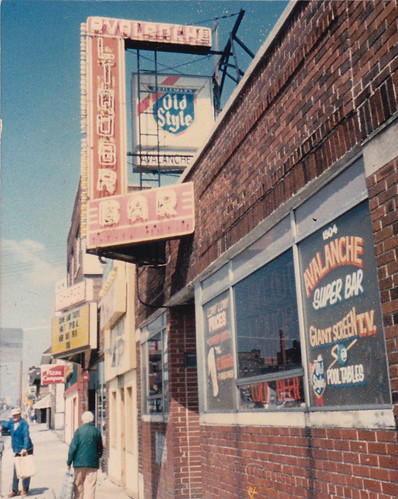
At that time, chalking sidewalks was done by nearly every organization on campus - advertisements for happy hours on Wells Street; study abroad meeting notices; campus ministry volunteer opportunities - they were all broadcast by chalk. (There was no email or texting or cellphones then, remember, so groups had to chalk boards or sidewalks to get news out.) In Milwaukee in the spring, they'd last a few days and then it would inevitably precipitate in some form and there was a tabula rasa for new notices ready and waiting. And there had never been any movement by anyone at the school to wash anything off before. It had been okay to tout 50 cent tappers at the 'Lanche, Ladies night at O'D's, frat parties and poster sales at the Union.
So why was the University power washing sidewalks to remove "Gay is okay"? I was stunned. And went home and thought about it, decided it was illogical, wrote a letter to the Marquette Tribune, and started coming out by showing my letter to one of my roommates and asking his thoughts.
All this was in my mind on Friday when our alma mater got mentioned in the NY Times. Not for great undergraduate education, however, or professorial research, or even for men's basketball, but for discrimination.
As reported in the NY Times and in more depth in the Journal Sentinel, Dr. Jodi O'Brien, a soiciologist and professor at Seattle University, was offered a position at Marquette University to be Dean of the College of Arts and Sciences, accepted the offer, and then had the offer rescinded after intercession by the President's Office.
Dr. O'Brien is an out lesbian who did nothing to hide her orientation during the interview process. I don't know how she could have, given her scholarly writings. The search committee made it an explicit point that she was lesbian. From the Journal Sentinel:
So now Fr. Wild, who has done a ton of good work for Marquette in moving the institution beyond some of its more shameful past and positioning it as a place that's affirming of GLBT students, says, effectively, "We didn't read her work closely enough and she's anti-family"!?
First, this discriminatiion has a personal side, as discrimination always does. The woman at the heart of the story, Dr. O'Brien, was offered a significantly bigger job, across the country. Have you ever had that experience? I have - it's exciting! You look at neighborhoods, you tell loved ones, you look at cost of living calculators, you start planning all of the thousands of details that go into a move like this. You give your landlord notice or you put your house up for sale; you make an announcement at work; when is your last day and when will be your first, and if you can afford a vacation in between; you wonder if it's the right thing to do. You wonder who's a good dentist, where the bus routes go, who has a decent cup of coffee... it's exciting and stressful and becomes all-consuming.
This woman, it now looks like, will be staying in Seattle at least another year, with colleagues who know she was looking and had an offer. Awkward at best. She has a secure position so unlike the thousands and thousands of queer Americans who are discriminated against every day in this country, she won't be out in the cold - but she had in her hands an offer for what was likely a significant salary jump, and she had it pulled from her. How must that feel? I'd be enraged, insulted, and on the phone with a lawyer.
What about MU? What had they hoped, with this decision? Everyone on campus is now talking about discrimination, everyone is thinking about the role of queer folk in the life of religious institutions, the campus is being engaged in discourse about the visibility of queer folk, how to live up to the official University position of Cura Personalis.
A university is an open place, a place for ideas and discourse and for all ideas being on the table. A Jesuit university, at its best, is a place where everyone can engage in the conversation and at which every idea can be examined, held up to scrutiny, weighed and debated and evaluated and tested.
MU at its best truly educated me. I can only hope this ham-fisted, clumsy attempt to disregard its intellectual heritage and to turn its back on a hire that could further help lead it to intellectual excellence will not stick, any more than pressure washing sidewalks did a generation ago.
Marquette knows better, and the resulting conversation may yet prove that to be true. In the meantime, for all those questioning GLBTQ in the Marquette family, now's a great time to have the conversation with your loved ones. And for those of us who are already out, it's a great time to challenge our school to be the best it can be.
And Dr. O'Brien, I hope to see you in Marquette Hall at some point!
.
In grad school at the U of Hawai`i I found far more dogmatism than I found in my undergrad at conservative, Catholic, Jesuit Marquette. At UH there were simply ideas that were off the table, or that were considered too inflammatory to discuss.
At Marquette? We talked about reporductive rights in one of my very first classes on campus, Phil 050. I was shocked. I knew the Church's position, and here we were talking about other ideas and viewpoints. Here were people who thought a woman had a right to choose whether or not to end her pregnancy! I was shocked - I'm not kidding, I'd never met anyone who had espoused that viewpoint before. And while it was a minority opinion in that classroom, it was discussed and considered and people who thought differently from you were treated with respect, even as you disagreed with them.
I learned about academic freedom, and that one of the things that the Jesuits held dear was that there must be a free exchange of ideas for there to be education - not training, but real education - to happen.
MU didn't always live up to its lofty ideals. One chilly morning in 1989 I was stunned when I realized what the maintenance workers were doing with a high pressure hose outside LaLumiere Hall - they were pressure washing the sidewalks. Someone had gone around campus the night before and had chalked "Gay is okay" at various points around campus.
Chalked.
At that time, chalking sidewalks was done by nearly every organization on campus - advertisements for happy hours on Wells Street; study abroad meeting notices; campus ministry volunteer opportunities - they were all broadcast by chalk. (There was no email or texting or cellphones then, remember, so groups had to chalk boards or sidewalks to get news out.) In Milwaukee in the spring, they'd last a few days and then it would inevitably precipitate in some form and there was a tabula rasa for new notices ready and waiting. And there had never been any movement by anyone at the school to wash anything off before. It had been okay to tout 50 cent tappers at the 'Lanche, Ladies night at O'D's, frat parties and poster sales at the Union.
So why was the University power washing sidewalks to remove "Gay is okay"? I was stunned. And went home and thought about it, decided it was illogical, wrote a letter to the Marquette Tribune, and started coming out by showing my letter to one of my roommates and asking his thoughts.
All this was in my mind on Friday when our alma mater got mentioned in the NY Times. Not for great undergraduate education, however, or professorial research, or even for men's basketball, but for discrimination.
As reported in the NY Times and in more depth in the Journal Sentinel, Dr. Jodi O'Brien, a soiciologist and professor at Seattle University, was offered a position at Marquette University to be Dean of the College of Arts and Sciences, accepted the offer, and then had the offer rescinded after intercession by the President's Office.
Dr. O'Brien is an out lesbian who did nothing to hide her orientation during the interview process. I don't know how she could have, given her scholarly writings. The search committee made it an explicit point that she was lesbian. From the Journal Sentinel:
Psychology professor Stephen Franzoi, who served on a search committee for the post, said faculty members forwarded two candidates to Marquette President Father Robert A. Wild and Provost John Pauly. In their recommendation, committee members warned Wild and Pauly not to pick O'Brien if the university was not willing to support her if her sexual orientation or if her scholarship were criticized, Franzoi said.
So now Fr. Wild, who has done a ton of good work for Marquette in moving the institution beyond some of its more shameful past and positioning it as a place that's affirming of GLBT students, says, effectively, "We didn't read her work closely enough and she's anti-family"!?
First, this discriminatiion has a personal side, as discrimination always does. The woman at the heart of the story, Dr. O'Brien, was offered a significantly bigger job, across the country. Have you ever had that experience? I have - it's exciting! You look at neighborhoods, you tell loved ones, you look at cost of living calculators, you start planning all of the thousands of details that go into a move like this. You give your landlord notice or you put your house up for sale; you make an announcement at work; when is your last day and when will be your first, and if you can afford a vacation in between; you wonder if it's the right thing to do. You wonder who's a good dentist, where the bus routes go, who has a decent cup of coffee... it's exciting and stressful and becomes all-consuming.
This woman, it now looks like, will be staying in Seattle at least another year, with colleagues who know she was looking and had an offer. Awkward at best. She has a secure position so unlike the thousands and thousands of queer Americans who are discriminated against every day in this country, she won't be out in the cold - but she had in her hands an offer for what was likely a significant salary jump, and she had it pulled from her. How must that feel? I'd be enraged, insulted, and on the phone with a lawyer.
What about MU? What had they hoped, with this decision? Everyone on campus is now talking about discrimination, everyone is thinking about the role of queer folk in the life of religious institutions, the campus is being engaged in discourse about the visibility of queer folk, how to live up to the official University position of Cura Personalis.
A university is an open place, a place for ideas and discourse and for all ideas being on the table. A Jesuit university, at its best, is a place where everyone can engage in the conversation and at which every idea can be examined, held up to scrutiny, weighed and debated and evaluated and tested.
MU at its best truly educated me. I can only hope this ham-fisted, clumsy attempt to disregard its intellectual heritage and to turn its back on a hire that could further help lead it to intellectual excellence will not stick, any more than pressure washing sidewalks did a generation ago.
Marquette knows better, and the resulting conversation may yet prove that to be true. In the meantime, for all those questioning GLBTQ in the Marquette family, now's a great time to have the conversation with your loved ones. And for those of us who are already out, it's a great time to challenge our school to be the best it can be.
And Dr. O'Brien, I hope to see you in Marquette Hall at some point!
.
06 May 2010
UK Election Results - first thoughts
It was a bad election for Labour, no question.
For those of you who have a life and haven't been following UK politics, Labour were of course going to have a rough night and a bad election. They have been in power since Tony Blair led the New Labour tide almost exactly thirteen years ago and they were tired and saddled with a poor economy, two deeply unpopular wars and the baggage of over a decade of consecutive governance and three consecutive Labour victories. Tony Blair might be Britain's President Clinton - smart, loved and reviled, a huge personality who overshadowed his successor. But instead of Al Gore running during a time of peace and prosperity, imagine him running after the economy crashed and the nation was enquagmired in two wars.
What's shocking is not that Labour is having a bad night, it's that David Cameron, the Tory leader (Tory = Conservative), hasn't managed to close the deal with the British people. Tonight should be an absolute shellacking, and it's not. The Tories might yet win an absolute majority (in the UK parliament, the party with 326 seats) - but the fact that it's in doubt has to be disappointing to the Tories.
After a debt crisis in Greece has people are talking - irresponsibly and hyperbolically, in my opinion - about the unravelling of the Euro, and the Tories, long the party of Euro- scepticism, aren't way in front?
After Labour holding power for 13 years and governing over the worst economic crisis since the War, and the Tories aren't walking all over them?
After souring public opinion about the wars and how Blair lied their nation into them, and the Tories aren't tonight taking a bow and forming a government?
After even their friends tired of Labour, as shown by the reliably red Guardian endorsing the Liberal Democrats, and the Conservatives didn't have this sewn up weeks ago?
What's shocking tonight is not that Labour are losing seats, possibly up to the triple digits. What's shocking is that, even with every possible advantage in an election cycle, the Conservative party wasn't able to capitalize. Might that be because Cameron, the Conservative leader, wasn't able to convince Britons that he was to be trusted with governance?
It's at least a part.
More on the results in the morning, but don't believe the hype of what you'll see in the headlines of the American newspapers. By all projections it will STILL be the case that the two left of center parties in UK life, the Liberal Democrats and Labour, will win over 50% of the vote. Cameron, whatever else Tories may make of him, is not the answer to their long drouth of leadership.
And Britain remains a center left nation.
.
For those of you who have a life and haven't been following UK politics, Labour were of course going to have a rough night and a bad election. They have been in power since Tony Blair led the New Labour tide almost exactly thirteen years ago and they were tired and saddled with a poor economy, two deeply unpopular wars and the baggage of over a decade of consecutive governance and three consecutive Labour victories. Tony Blair might be Britain's President Clinton - smart, loved and reviled, a huge personality who overshadowed his successor. But instead of Al Gore running during a time of peace and prosperity, imagine him running after the economy crashed and the nation was enquagmired in two wars.
What's shocking is not that Labour is having a bad night, it's that David Cameron, the Tory leader (Tory = Conservative), hasn't managed to close the deal with the British people. Tonight should be an absolute shellacking, and it's not. The Tories might yet win an absolute majority (in the UK parliament, the party with 326 seats) - but the fact that it's in doubt has to be disappointing to the Tories.
After a debt crisis in Greece has people are talking - irresponsibly and hyperbolically, in my opinion - about the unravelling of the Euro, and the Tories, long the party of Euro- scepticism, aren't way in front?
After Labour holding power for 13 years and governing over the worst economic crisis since the War, and the Tories aren't walking all over them?
After souring public opinion about the wars and how Blair lied their nation into them, and the Tories aren't tonight taking a bow and forming a government?
After even their friends tired of Labour, as shown by the reliably red Guardian endorsing the Liberal Democrats, and the Conservatives didn't have this sewn up weeks ago?
What's shocking tonight is not that Labour are losing seats, possibly up to the triple digits. What's shocking is that, even with every possible advantage in an election cycle, the Conservative party wasn't able to capitalize. Might that be because Cameron, the Conservative leader, wasn't able to convince Britons that he was to be trusted with governance?
It's at least a part.
More on the results in the morning, but don't believe the hype of what you'll see in the headlines of the American newspapers. By all projections it will STILL be the case that the two left of center parties in UK life, the Liberal Democrats and Labour, will win over 50% of the vote. Cameron, whatever else Tories may make of him, is not the answer to their long drouth of leadership.
And Britain remains a center left nation.
.
Gay bashing Baptist Preacher in Hookergate - Update
This summary is not available. Please
click here to view the post.
05 May 2010
"But Jesus hung out with prostitutes, too!"
This summary is not available. Please
click here to view the post.
03 May 2010
Washed up
I'd bought it to be a beach blanket, and it was already in the trunk. I saw it when I threw my bag in the trunk, my new orange blanket from Ikea with the unpronounceable Swedish name, as I left for school visits in San Luis Obisbo and Santa Barbara. On my way back to LA that day in 1999, I pulled off the 101 in the brilliant afternoon sunshine to hit the beach. 
I took it down to the sand, threw it out, anchored it with my slippahs, and stretched out in the balmy sunshine. At the end of my reading material an hour later, I started to pack up, mindful of when I'd hit LA traffic, and that's when I saw it: big black gobs of goo on my feet! I was shocked - so shocked that it took me a while to realize what the big gobs of black, gooey stuff could be. I scrounged around for a stick and scraped off as much as I could, and then went into the surf to try and get the rest off. But it wouldn't come off! I kept stepping in more, and now as I looked it was everywhere. I'd rub my feet on rocks and with the stick to get the globs off, but my feet were stained, and no matter how much I scrubbed with sand and sea water, and no matter much kept coming off, there was still more. After about 20 minutes I declared my feet clean, but then I noticed my slippahs were covered - so I repeated the process and got as much off of them (new stick) as I could and put them back on, recontaminating the soles of my feet with what I couldn't really get off from the decks of my slippahs. I then shook out my blanket and saw the globs there! I shook out the sand, balled it up and trudged back up to my car, feeling violated.
Later at the Goleta Coffee Company for a post-beach fuel-up, I struck up a conversation with some locals, told them about the tar, and displayed my raw and rubbed-red feet, still stained. They confirmed my suspicions - it wasn't tar, it was crude oil. From a spill off the coast. In 1969, 30 years earlier.
Before I got home I stopped at a hardware store for turpentine, used my t-shirt as a rag to clean up my slippahs and my feet, and tried to get the  worst of it out of my beach blanket. Finally I realized the only thing to do was to cut it out of the material so it wouldn't keep spreading onto other surfaces, so I did (right). My trip to the beach had cost me a t-shirt, a can of turpentine, a few hours of cleaning time, and a hole in my new Ikea blanket. Despite my best efforts, I suspect someone at Avis had a helluva time getting the brake and gas pedals clean.
 worst of it out of my beach blanket. Finally I realized the only thing to do was to cut it out of the material so it wouldn't keep spreading onto other surfaces, so I did (right). My trip to the beach had cost me a t-shirt, a can of turpentine, a few hours of cleaning time, and a hole in my new Ikea blanket. Despite my best efforts, I suspect someone at Avis had a helluva time getting the brake and gas pedals clean.
 All this from an oil spill that happened thirty years earlier.
What's going to happen in the Gulf of Mexico? What's going to be the effect in thirty years on the beaches of Louisiana, Mississippi, Alabama, and yes, Florida and Texas? What's going to happen to the fisheries and shrimp grounds and to all of the people who depend upon them for their livelihoods? I heard President Obama say today that BP is going to be on the hook for the cost, but what cost? In 30years is BP going to pay for a beach-goer's turpentine, t-shirt and beach blanket?
There is simply no way to pay for the costs of an oil spill like the one happening right now 5000 feet below sea level on the floor of the Gulf of Mexico. The costs are incalculable. And until all the costs - ALL the costs - of a petroleum based economy are captured at the consumer level, then we will make irrational decisions about our energy consumption, and keep buying artificially cheap gas and the cars that burn it.
When I pay $3.12 for a gallon of gas up the street at the Shell station, that does not cover the costs of the oil spill in the Gulf of Mexico, or the defense budget it takes to ensure enough supply, or the long term effects that my using that gas will have on a warming environment, or the asthma of a child in Long Beach who is growing up downwind of the harbor and who breathes in bunker fuel exhaust from an ocean tanker bringing in raw crude oil to the refineries in Wilmington.
What is the real cost of a gallon of gas? It's nearly mpossible to calculate.
When President Obama earlier this year signalled that he was going to open parts of Alaska, the Atlantic seabed, and additional areas in the Gulf to oil production, I was deeply disappointed and I thought strongly that it was the wrong policy - but I understood the motivation. What are we supposed to do? We burn the stuff, and we burn more than we have. What are we supposed to do? What's the solution? Use less and switch the hell off of it before we destroy the planet, bankrupt ourselves in favor of some of the worst people in the world, and run out, sure. But even if we all decided tomorrow that was the right course to pursue - and we won't, but even if we did - it will take decades to get there.
When I had that experience back in '99, I was annoyed (and for several days after I kept that tshirt and turpentine handy, as there was a lot of "how did oil get THERE?!") but smug. I didn't own a car, so I was not part of the problem. Never mind that I sure used jet fuel, that I rented a car for work purposes for over half the weeks of the year that didn't run on fairy dust, that I bought consumer goods and foods made all over the world that were flown or shipped in to my local store - I was not part of the problem.
I was wrong then, and my smugness embarrasses me in hindsight. The worse thing is that I'm an even greater part of the problem now. I drive everywhere. My bike got stolen and I almost never take the train anymore, even though it goes to just a few blocks from work. I still fly an awful lot - I'm dating someone in Georgia, for the gods' sake!
I remember feeling a little sick after I realized what I'd stepped in on that beach in 1999, and that it had washed up from thirty years before. I wondered how many decades it would take for that washed up oil to really be "cleaned up." After I'm gone, it's safe to say, is one answer.
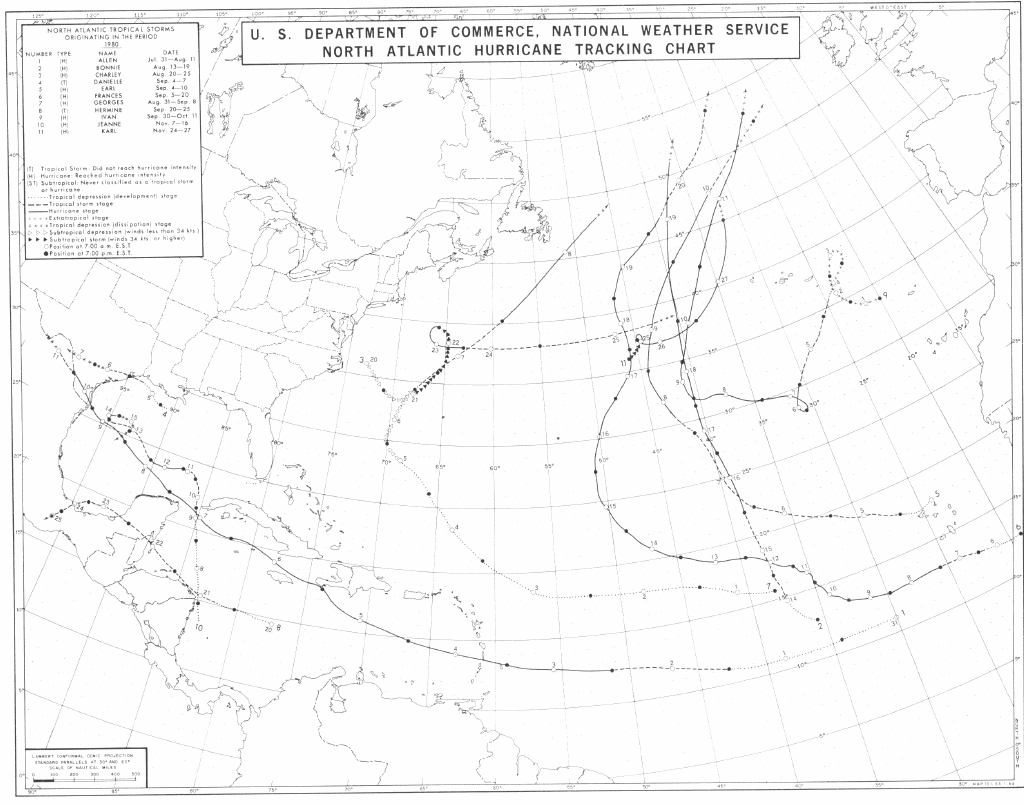
By the time hurricane season comes, in just twenty eight days, with possible onshore storm surges pushing Gulf seawater - and crude oil - miles into the delicate estuaries along the coast, and winds of more than 70 miles an hour lifting Gulf seawater spray and foam - and crude oil - and blowing it miles and miles inland, maybe the spill will have been "cleaned up." Maybe by then the leak will have been stanched, and the 200,000 gallons of crude oil currently shooting into the Gulf everyday from an oil deposit another 18,000 feet below the sea floor will have been greatly diminished, or stanched all together. Maybe it will be a hurricane season like 1980, when no storms hit the current spill area.
But I'm not particularly hopeful.
There's no question that it's the Louisiana and Mississippi Gulf Coast residents who will pay a disproportionate share of the damage, whatever damages turn out to be, and that my $3.12 a gallon isn't going to begin to cover the cost. And all that crude oil, floating on the water - getting stirred up by winds, suffocating even more of the Gulf of Mexico ecosystems - means that a lot more than crude oil is going to be all washed up.
There is simply no way to pay for the costs of an oil spill like the one happening right now 5000 feet below sea level on the floor of the Gulf of Mexico. The costs are incalculable. And until all the costs - ALL the costs - of a petroleum based economy are captured at the consumer level, then we will make irrational decisions about our energy consumption, and keep buying artificially cheap gas and the cars that burn it.
When I pay $3.12 for a gallon of gas up the street at the Shell station, that does not cover the costs of the oil spill in the Gulf of Mexico, or the defense budget it takes to ensure enough supply, or the long term effects that my using that gas will have on a warming environment, or the asthma of a child in Long Beach who is growing up downwind of the harbor and who breathes in bunker fuel exhaust from an ocean tanker bringing in raw crude oil to the refineries in Wilmington.
What is the real cost of a gallon of gas? It's nearly mpossible to calculate.
When President Obama earlier this year signalled that he was going to open parts of Alaska, the Atlantic seabed, and additional areas in the Gulf to oil production, I was deeply disappointed and I thought strongly that it was the wrong policy - but I understood the motivation. What are we supposed to do? We burn the stuff, and we burn more than we have. What are we supposed to do? What's the solution? Use less and switch the hell off of it before we destroy the planet, bankrupt ourselves in favor of some of the worst people in the world, and run out, sure. But even if we all decided tomorrow that was the right course to pursue - and we won't, but even if we did - it will take decades to get there.
When I had that experience back in '99, I was annoyed (and for several days after I kept that tshirt and turpentine handy, as there was a lot of "how did oil get THERE?!") but smug. I didn't own a car, so I was not part of the problem. Never mind that I sure used jet fuel, that I rented a car for work purposes for over half the weeks of the year that didn't run on fairy dust, that I bought consumer goods and foods made all over the world that were flown or shipped in to my local store - I was not part of the problem.
I was wrong then, and my smugness embarrasses me in hindsight. The worse thing is that I'm an even greater part of the problem now. I drive everywhere. My bike got stolen and I almost never take the train anymore, even though it goes to just a few blocks from work. I still fly an awful lot - I'm dating someone in Georgia, for the gods' sake!
I remember feeling a little sick after I realized what I'd stepped in on that beach in 1999, and that it had washed up from thirty years before. I wondered how many decades it would take for that washed up oil to really be "cleaned up." After I'm gone, it's safe to say, is one answer.
By the time hurricane season comes, in just twenty eight days, with possible onshore storm surges pushing Gulf seawater - and crude oil - miles into the delicate estuaries along the coast, and winds of more than 70 miles an hour lifting Gulf seawater spray and foam - and crude oil - and blowing it miles and miles inland, maybe the spill will have been "cleaned up." Maybe by then the leak will have been stanched, and the 200,000 gallons of crude oil currently shooting into the Gulf everyday from an oil deposit another 18,000 feet below the sea floor will have been greatly diminished, or stanched all together. Maybe it will be a hurricane season like 1980, when no storms hit the current spill area.
But I'm not particularly hopeful.
There's no question that it's the Louisiana and Mississippi Gulf Coast residents who will pay a disproportionate share of the damage, whatever damages turn out to be, and that my $3.12 a gallon isn't going to begin to cover the cost. And all that crude oil, floating on the water - getting stirred up by winds, suffocating even more of the Gulf of Mexico ecosystems - means that a lot more than crude oil is going to be all washed up.
Subscribe to:
Posts (Atom)